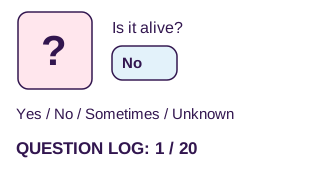
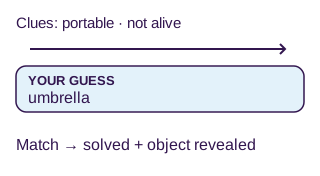
A hidden object can occupy a surprisingly large amount of conversation. Someone pictures a grand piano; someone else has already decided it must be a sandwich. Both may be reasoning carefully, but from different starting assumptions. The pleasure of Twenty Questions comes when a useful question makes those private pictures change together. A guess provides an answer to applaud or reject. A question can provide a new landscape in which everybody gets to think.
This is why the host matters as much as the people guessing. The host protects one small piece of information and supplies consistent replies, while the investigators decide what they still need to know. Quirky Query Hub records their questions and the host's answers; it does not understand arbitrary sentences or conduct an artificial intelligence interrogation. That limitation can be useful. It makes interpretation a visible human responsibility instead of disguising a vague answer behind a supposedly intelligent machine.
An investigation needs a shared picture
Before the first question, settle what kind of thing could be hidden. An everyday object round works differently from a round that allows animals, places and imaginary inventions. You need not announce the exact bank category if discovering it is part of the challenge. You do need agreement about the possible world. Otherwise, a person investigating ordinary objects can spend ten questions excluding things that another player never considered eligible.
Use the visible log as a shared work surface. After several turns, ask somebody who has not spoken recently to summarize what is established. The task is not to recite every answer. It is to distinguish evidence from a tempting picture: human-made, used indoors, not ordinarily carried in a pocket. “It probably belongs in a kitchen” may be a reasonable hypothesis, but it is not yet a recorded fact. Keeping that difference audible allows another player to disagree without appearing to disregard the investigation.
Some questions are valuable because they divide possibilities. Others are valuable because they repair a misunderstood answer. A room can become overconfident about its own definitions. Does portable mean a person can lift it, or that people ordinarily take it elsewhere? Is a thing electronic because an electronic version exists? A brief clarification is better than building the rest of the round on two incompatible meanings. The host should answer for the agreed ordinary version, naming an uncertainty when the wording does not support a clean yes or no.
Fictional Example: the rehearsal-room mystery
The following is an illustrative story about a custom-answer round, not a report of an actual gathering. At a community theater rehearsal, six volunteers have twelve minutes before the lighting technician arrives. They want something that includes the two people who have just joined the production. Their usual game of guessing memorable rehearsals would favor established members, so Bea volunteers to host a hidden object instead. She enters a custom answer, “metronome,” checks that nobody can see the host screen and closes it before handing the phone to the questioner.
The group begins confidently. Is it human-made? Yes. Is it usually found indoors? Yes. Is it useful in a kitchen? No. An actor called Malik declares that this leaves office equipment, and the next questions chase staplers, printers and desk lamps. Tessa, a new volunteer, says nothing until Bea asks her to summarize the log. Tessa notices that no answer actually mentioned an office. She asks whether the object has anything to do with sound. Bea records Yes. The group's imaginary office disappears almost instantly.
This is the first turn in the story: the least established participant does not produce a brilliant guess. She identifies an assumption that became invisible because everybody liked it. Malik starts to suggest a radio, but pauses and asks whether it is used to hear recorded music. No. Someone else asks whether a performer uses it. Yes. At this point they have a useful direction, although two people are thinking of very different instruments. Bea reads back the question wording rather than adding a suggestive comment about rehearsal.
Then a difficult question arrives: does it make music? Bea hesitates. A metronome makes an audible beat, but she would not ordinarily call that music. Instead of treating her hesitation as a secret clue, she asks the questioner to specify the meaning. They revise it to ask whether the object ordinarily produces a melody. No goes into the log. The clarification is not a free hint about the object. It prevents an ambiguous phrase from acquiring a false precision. Everybody can see which proposition the answer belongs to.
When Tessa proposes a metronome, Malik wants one more question before entering it: is its purpose to help someone keep a steady pace? Bea records Yes. Tessa uses the separate guess field and the round ends. The group does not pretend that every earlier office question was wasted. Those questions excluded several possibilities, but their most useful discovery was that the office itself had never been established. They finish with Bea explaining why she requested the melody clarification. There is time for a second host, and Malik offers Tessa the answer screen privately rather than assuming she wants another guessing role.
The practical lesson is about distribution of useful work. The loudest participant need not become the only question designer. A summary role can reveal a missing distinction without requiring a fast guess. If you reproduce this structure, rotate who summarizes after several questions and keep the summary separate from the official question count. Do not claim the browser automatically gives every player a formal investigation role; the host organizes that conversational turn. Use the app's log to support the arrangement, and let a person decline the summary just as they can decline an ordinary turn.
The host's hardest answer is sometimes “unknown”
Being a host does not mean inventing certainty. A hidden animal might have an unusual exception, or a familiar object might exist in several forms. A Sometimes or Unknown response can preserve the round when the host cannot responsibly choose Yes or No. Its value depends on restraint. If every straightforward question receives a mysterious qualified answer, the investigators cannot narrow anything. If a qualification is necessary, explain the boundary without describing the hidden thing. “Answering about the usual adult form” supplies a consistent convention; a lecture containing the animal's distinctive behavior may supply the solution.
It also helps to distinguish an ambiguous question from a question the host cannot answer. “Is it heavy?” lacks a comparison. “Does its ordinary form weigh more than a full shopping bag?” is clearer, but the host may still not know. Those are different problems. Ask for clearer wording in the first case and record uncertainty in the second. A friendly group need not turn an imperfect round into a research tribunal. It can choose another question, accept the uncertainty and discuss it after the reveal. The log then represents the actual investigation rather than an idealized one nobody really conducted.
Illustrative Scenario: a pair investigates without racing
In a second fictional example, cousins Priya and Sol are visiting an older relative who prefers a quiet table to a competitive party. Their relative hosts a custom answer, “bookend.” Priya tends to guess immediately, while Sol needs time to picture the alternatives. Instead of assigning points to the fastest voice, they agree to alternate questions and allow one brief discussion before each entry. The browser continues to manage the shared twenty-question allowance; this speaking arrangement is something the people choose around it.
Priya discovers that the object is human-made and often sits on a shelf. She wants to guess a framed photograph. Sol asks whether its principal purpose is decoration. Their host answers No. They discover that it supports something else. Priya suggests a shelf bracket, then notices that the question log never established attachment to a wall. Sol asks whether it can usually be moved without tools. Yes. They are now close, but Sol offers “book stand” as a description rather than an exact name. Their host asks whether they mean an object holding a book open or one preventing upright books from falling sideways.
The cousins choose to ask a final clarifying question about sideways support before using the guess field. They reach bookend and compare the two ideas afterward. The distinction between holding one book open and supporting several books matters more than who first said “book.” Nobody claims that the app automatically recognized the whole conversation or awarded partial credit for a description. The host managed meaning, and the final typed guess used the chosen custom answer. In their next round, they avoid a custom object with a disputed regional name so that spelling will not dominate the outcome.
This arrangement suits a small, unevenly paced group because it separates speaking speed from investigative contribution. It does not remove challenge: each question still uses the shared allowance and every answer still changes the remaining possibilities. It removes one unnecessary obstacle, the need to interrupt first. If you play this way, announce the turn order before opening the answer screen. Changing it midway only to slow one successful player can feel like a penalty; choosing it together at the beginning makes it an ordinary feature of the session.
When the twentieth question arrives
A nearly solved mystery can make people bargain with the rules. They want another broad question, a half-guess disguised as a question, or a host's facial expression to confirm a candidate. Agree before play whether an explicit guess belongs in the separate guess field and what will happen at the allowance. In this tool the question counter and final-guess control serve different purposes. Read the current prompt rather than assuming an unlimited conversation will continue. An ending is easier to accept when it was part of the opening agreement.
After an unsuccessful final guess, reveal the object without making defeat the only subject. Ask which recorded answer most changed the group's direction and which question turned out to be ambiguous. The first question identifies useful reasoning; the second improves the next host's practice. Avoid reconstructing the round as though the answer had been obvious all along. Once you know it, clues arrange themselves neatly. The investigators did not have that convenience while choosing. A fair discussion remembers their actual information at each decision, including any uncertainty the host recorded.
A replay can compare question strategies, but it is no longer an independent test once people know the answer. Tell the group if you are demonstrating a shorter route rather than running another mystery. For example, ask how the rehearsal group might have tested the sound hypothesis earlier, then stop before pretending the resulting guess was earned fresh. For a new live round, draw another object or let a new host supply a custom one privately. Replaying a known answer can teach question construction; it cannot recover the original uncertainty simply by clearing the screen.
One question at a time on a crowded table
When several players suggest questions together, collect the suggestions before entering one. Name the question the group is actually submitting and wait for the host's recorded reply. Otherwise a single Yes can become attached in memory to three overlapping sentences. A reader can repeat the selected wording while another person operates the device. That division is particularly helpful when a group is gathered around a small screen and only the nearest person can see the input clearly.
Keep the rejected suggestions available as possibilities, not as answered questions. A player might ask about size while somebody else proposes material; choosing the size question does not establish anything about material. On the next turn, check whether that unanswered proposal is still useful. This simple discipline keeps a lively group from accidentally acquiring information the host never supplied. It also gives a person whose idea was not selected a clear route back into the investigation without having to interrupt the next speaker.
A small preparation that improves the next round
Choose custom objects you can explain consistently. Before entering one, silently test a few broad questions: living, human-made, ordinary setting and main use. If several answers depend on an unusual technical variant, choose a more stable object for this group. The challenge should come from the investigators' choices, not from discovering that the host had a rare museum specimen in mind. A more specialist group may enjoy that scope, but it needs to know the scope exists. Shared knowledge is a resource to design around rather than an excuse to exclude newcomers.
Prepare the physical handoff as carefully as the question. Read the hidden answer privately, close the host-only section and verify that the public log is the part facing the group. If someone glimpses the answer accidentally, use another object instead of spending the round assessing whether they really saw it. The tool's privacy controls help organize a shared device; they do not prevent someone standing behind the host from looking at the screen. Position and cooperation remain part of the activity. A fresh mystery is usually cheaper than a lingering argument about a spoiled one.
End by giving the next host a choice of role. Some people enjoy protecting the secret more than pursuing it; others want to investigate with less responsibility for definitions. A session can contain one excellent mystery and a long conversation about its turning point. It does not need to consume every available object. The useful ending is the moment people can explain how a question changed what they thought, and want to carry that curiosity into another round. Leave them with an unresolved new object only if they actually want one, not because the counter makes continuing look obligatory.