An imaginary crisis can be delightfully impractical. A clock tower begins snoring, streets fill with a pillow fog, and the town still wants to hold its fair. The choices are not instructions for an actual emergency. They are invitations to decide what this little fictional community values, then watch how a few recorded actions alter its route. A cheerful welcome may cost supplies. A practical reserve may leave less time for celebration. The interest lies in making those priorities visible rather than discovering one secret choice that proves everybody else wrong.
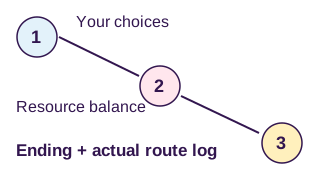
Apocalypse Survival Decision supplies authored scenes, offered options, changes to supplies and morale, and an ending connected to the resulting state. The browser does not improvise an unlimited world or judge a player's personal morality. Its small model is a storytelling device. Read the actual choices and their stated consequences, follow a route and compare the ending with the decisions you made. A group can enjoy discussing alternatives without pretending those two numbers capture the complexity of helping people in real life. The fictional distance is part of what makes the conversation comfortable.
Decide whose story you are telling
Before choosing a route, agree whether the group wants to act as a committee, follow one spokesperson or rotate who makes the final selection. These arrangements create different experiences. A committee can debate every trade-off; a rotating chooser gives each person a consequential turn. The tool records the selected option, not an automatic ballot among everyone in the room. If you want a vote, organize it openly before someone presses a choice. Do not treat the person holding the device as the unannounced leader simply because their thumb is closest to the screen.
It also helps to choose a modest narrative intention. Perhaps this town wants a fair where newcomers feel welcome, or a workshop ready for tomorrow. An intention gives discussion a reference without guaranteeing a particular ending. People can revise it when the authored scene changes. Do not demand that every player invent a detailed character biography before starting; some will prefer to consider the visible options as themselves. Roles are an optional way to explore motives, not an extra game system the browser secretly provides. Keep any invented roles separate from what the page actually stores.
Fictional Example: the invitation that used the last fabric
The participants and dialogue in this case are fictional; the route and resource changes come from the live story The Great Pillow Fog. Three neighbors, Asha, Leon and Viv, gather after a craft club meeting. They choose that story because its absurd atmosphere feels lighter than a realistic disaster. Supplies and morale begin at six each. They decide to speak as the town's fair committee, with a different person reading each event. The first problem is the snoring clock tower and the choice of headquarters.
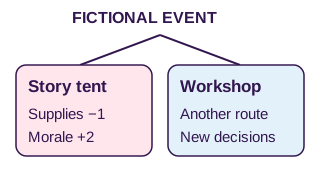
Asha favors a cheerful story tent in the square. Leon wants a quiet workshop in the old station because it adds supplies, but Viv asks what their committee wants the fair to feel like. They choose the tent, which changes supplies to five and morale to eight. They do not declare the workshop a bad answer. It represents another priority they may try later. The first click is useful because it turns a broad preference for welcoming people into a visible cost and benefit. Their story now has a place for visitors to gather.
At the tent, visitors arrive carrying pillows instead of tickets. The committee can trade spare fabric for colorful invitation flags or save the fabric and lend drawing pencils. Leon pictures a town that will run out of materials before sunset. Asha imagines neighbors unable to find the fair through the fog. Viv, reading the options, insists that they choose one of the offered actions rather than inventing a free third plan that receives every advantage. They trade fabric for flags. Supplies fall to two and morale rises to twelve, and the route leads to the welcome desk.
More visitors arrive than expected. Asha now worries that her welcoming choice has created a practical problem, while Leon is tempted to say he predicted everything. Instead he proposes reading the next two options before judging the previous one. They can spend tokens on a clearer invitation or use reusable name tiles. The committee selects the invitation. Supplies reach zero and morale reaches fourteen. The room laughs at the notion of a committee using its last resources to invite more people, but they can also explain why the choice fit the story they were trying to tell.
At sunset, the fog asks what the fair has learned. They choose to give every visitor a turn in a shared bedtime story. Supplies become minus three and morale becomes eighteen. The ending is a shared celebration: the town feels sociable again without a claim that the strange fog has vanished. Leon points out that a negative supply value would be alarming if this were an actual planning model. Viv agrees and reads the outcome as a comic narrative consequence, not evidence that real communities should ignore material needs. Their achievement belongs to an authored entertainment system.
The turning point was not simply the final high number. It was the welcome-desk scene, where the group recognized a consequence of its own invitation strategy and chose to continue deliberately. Had Leon used that moment only to claim that the earlier voters were foolish, the discussion would have become a personal contest. Reading the new options allowed the fictional committee to remain a shared creation. The recorded history gives them a way to trace that choice afterward. They can disagree about the town's priorities while still recognizing how the route produced its ending.
A replay can answer a different question
When the first ending appears, a group may immediately ask for the best route. That word needs a criterion. Best at preserving supplies, best at producing a sociable finish and best at telling an amusing story are not necessarily the same request. Before replaying, state what you want to compare. One useful question is whether an early decision changes the scenes you encounter. Another is how the same final choice feels after a different resource history. A replay becomes more interesting when it investigates something specific rather than merely chasing a larger total.
Keep the original history visible in your notes if you want an accurate comparison. Memory tends to compress a route into one memorable decision. The supply cost of flags can overshadow the earlier tent choice or the later invitation. Reconstruct the sequence from the recorded selections, then compare another route one change at a time where the authored structure permits it. Do not assume every event can be visited in every order. Branches can send the story to different scenes, and a route can skip an event entirely. That is part of the design, not missing content to be filled by a host's imagination.
Illustrative Scenario: a solo reader chooses tomorrow
In this separate fictional case, a solo reader named Niko plays the same available story during a quiet break. Niko is interested in the station workshop rather than the town committee's invitation campaign. Starting again from six supplies and six morale, Niko chooses the old station: supplies become eight and morale becomes five. The route visits a bell that rings only when someone says something kind. Niko considers the thank-you cards but selects a reusable mechanical bell striker. Supplies rise to eleven and morale falls to four.
The next visited scene is the sunset question. Niko chooses a sturdy scrapbook of the town's inventions, accepting its quieter practical finish. Supplies become twelve and morale becomes two. The story ends prepared for tomorrow. It is not the same set of four decisions that the committee made: the workshop route reached a different intermediate event and then the final scene. Niko reads the ending as a community that has useful reserves but did not organize the shared celebration. The remaining fog is not treated as a bug that a sufficiently clever click should remove.
Niko then sketches a paper-only continuation about a caretaker opening the scrapbook the next morning. That imagined scene is not an additional branch secretly present in the tool. It is a writing response to the recorded ending, kept outside the live decision sequence. The distinction lets the browser provide a bounded story while the reader remains free to invent afterward. Niko gives the caretaker a small practical problem: a page describes the bell striker perfectly, but nobody wrote where it was stored. The new joke concerns documentation rather than a new supply mechanic.
This case offers another way to enjoy the activity. A solo player does not need to simulate a whole committee or perform several personalities. A clear personal intention can guide a short route, followed by a sentence about what that ending leaves unresolved. The paper continuation adds creative reading without changing the tool's recorded result. For a group, you could invite two voluntary continuations after an ending and compare the details they select. Label them invented extensions and avoid awarding them fictional app scores. The authored ending and the readers' responses can coexist without pretending they are the same feature.
Numbers can support a story without settling its meaning
Supplies and morale make consequences legible, but they should not replace reading the options. A choice may increase one resource while reducing the other; its wording tells you what that trade-off represents in the scene. If players discuss only the arithmetic, invite somebody to describe what the townspeople will actually do. If they discuss only the story, point back to the resource changes so the cost does not vanish from the conversation. Neither reading needs to dominate. The useful tension comes from holding the action and its simplified consequence together.
Avoid treating morale as an automatic measurement of the people in your actual room. A player favoring the workshop is not thereby less friendly, and someone choosing a welcoming story is not proving superior compassion. They may be testing the system, inventing a character or trying a route they did not choose last time. Ask what they wanted to explore before interpreting the decision. Fiction gives people space to make choices they would not make in ordinary life. A host can preserve that space by discussing the invented town rather than diagnosing the participant.
The same caution applies to the word survival. These stories use comic premises and deliberately small resource models. They omit the material, social and professional complexity of real emergencies. Do not present a successful ending as instruction about food, shelter, medicine or public safety. The game is valuable on its own terms: it can support a conversation about authored consequences, competing priorities and the different stories people find satisfying. It does not need borrowed real-world authority to justify an enjoyable half hour with a peculiar fictional town.
How to let disagreement improve the next scene
In a group, give each proposal one clear reason before open discussion. A person who speaks slowly can then place a priority in the room before the most enthusiastic storyteller builds a complete plan. Name the actual trade-off rather than the personality of the proposer: more supplies now, less morale now, a different route later. If a participant changes their mind after hearing another reason, treat that as useful collaboration, not inconsistency to mock. The committee is making a story together, not recording permanent political identities.
When the group cannot agree, use the decision method announced at the start. A rotating chooser can listen to both reasons and select; a majority can record a local vote before the device holder presses an option. Neither method is automatically implemented by this story tool. Explain the human process so a later result does not become an argument about who was entitled to decide. If competition is not serving the group, let two smaller groups discuss different routes in separate sessions rather than turning every click into a struggle for control of the same phone.
An unexpected ending is a reason to inspect history, not to rewrite it. Perhaps an early branch skipped the scene someone expected, or several small resource changes accumulated into a surprising balance. Read back the actual selections and their sequence. If you start another story, say that it is another story rather than implying the previous route can be edited retrospectively. Stored local data and JSON backups can preserve records where supported, but they are not an unlimited narrative rewind interface. Use the controls the page offers and distinguish analysis afterward from actions inside the live route.
Stop at an ending that invites conversation
Once the story resolves, ask which choice the group would keep even if it led to a less preferred ending. This question separates an action people enjoyed imagining from a number they wanted to maximize. Ask also which option they would explore on a replay. Those two answers can produce a useful next session without demanding that everybody exhaust every branch immediately. A short authored story has value because its limits make a shared discussion possible. It does not need to become an evening-long project to justify choosing it.
The Pillow Fog committee might keep its flags because they gave the fair a memorable image. Niko might keep the workshop because it supplied an ending worth extending on paper. Neither response erases the cost recorded by the system. They identify the kind of story each reader wanted. That is an appropriately modest conclusion for an absurd apocalypse: a few choices can leave different impressions, and a clear record lets people explain why. Close the story with its actual ending, leave real emergency planning to appropriate real-world guidance, and keep the fictional town available for another curious visit.