A squeaking chair is an inconvenience. A squeaking chair that makes a character miss an announcement, choose the wrong room, and discover that the right room has been beside them all along is becoming a story. The difference is not the seriousness of the problem. It is the connection between events. Build Your Worst Day invites a player to assemble five minor mishaps, replace individual events and give the finished combination severity and chaos ratings. The interesting creative work begins when those separate inconveniences start affecting the same imagined person.
The word “worst” can suggest a competition to invent something harsher. That is not necessary here. The tool's mild events offer a different pleasure: noticing how small frustrations can create a recognizably awkward rhythm without turning suffering into entertainment. A character may be inconvenienced, surprised, or forced to improvise. They do not need to be injured, humiliated, or deprived of something essential. A day can be wonderfully chaotic because a recurring detail keeps arriving at the wrong time, not because every successive event raises the stakes of harm.
Give the day a destination
Before connecting five events, decide what the fictional person is trying to finish. They may be delivering a handmade invitation, preparing a small display, or returning a borrowed object before lunch. The goal supplies a thread that the mishaps can interrupt. Without it, the player may simply read five unrelated complaints. With it, a sideways-writing pen can affect the invitation, an uncooperative umbrella can change the route, and a repeating tune can become a signal the character learns to anticipate. The same event takes on a different role depending on what the day needs to accomplish.
Do not make the goal so urgent that every harmless mishap begins to imply a serious loss. A leisurely fictional errand gives the reader room to enjoy detours. A situation involving medical care, real danger, or somebody's livelihood would change the tone of identical events. That is a useful editing decision, not a demand that the story pretend all frustration is pleasant. The game works best when the participants can recognize annoyance while remaining comfortable with the distance between a made-up day and their actual difficulties.
Fictional Example: the invitation that kept changing direction
This story is invented and uses a paper arrangement of minor mishaps. Its exact five-event sequence is not promised as a live random draw. Ada has agreed to deliver a handmade invitation to a fictional neighborhood conservatory before its afternoon opening. She has plenty of time and no emergency deadline. Her task is simple enough that the reader can follow it while the day becomes increasingly awkward. The invitation is the object she wants to protect, so each inconvenience can interfere with a recognizable intention rather than arriving as a disconnected surprise.
At breakfast, Ada discovers that her pen writes comfortably only when held at an unusual sideways angle. She turns the invitation instead of abandoning it, which leaves the address arranged along its edge. The solution works, but it establishes a recurring image: everything important on this day will need to be approached from a different direction. When her umbrella opens inside the hallway, she has to rotate it carefully through the door while keeping the invitation flat. The second event echoes the first without simply repeating the same joke.
Outside, a tiny jingle repeats from a fictional pocket music player that will not advance to the next track. Ada initially tries to walk faster than the tune feels, then finds herself slowing at the same musical phrase every time she checks a street sign. The story has not become about breaking or repairing an actual device. The sound is a rhythm that affects her route. At a corner she meets a volunteer carrying a plain sign toward the conservatory, and both realize they have been using the same tune as an accidental walking pace.
The fourth inconvenience is a shoelace that loosens whenever Ada passes through a doorway. At the conservatory entrance, she stops again. The volunteer offers to hold the invitation while she ties it, but the sideways address makes the envelope look as if it belongs to a different entrance. For the first time, Ada wonders whether she has arrived at the wrong door. The reader knows how that uncertainty grew: a successful adaptation in the first scene has become a small source of confusion later. The events are beginning to share consequences.
The final mishap is a sleeve carrying an unnoticed smear from breakfast. Ada sees the mark just as she is about to knock and tries to keep the invitation away from it. The movement turns the envelope so the sideways writing is easy for the volunteer to read. They identify the correct recipient's name, turn the sign the right way around, and enter together. Ada delivers the invitation without a grand rescue or a punishment. The day ends with a slightly untidy object reaching its destination because the character keeps making small adjustments rather than because the universe suddenly becomes cooperative.
The turn in this story is the return of the sideways address. It first looks like a minor solution, later causes uncertainty, and finally becomes readable when another inconvenience changes the angle again. That recurrence gives the sequence a shape. A host can ask players to look for a similar detail in their actual generated five events without requiring the same plot. Which object, sound, or gesture could appear twice? Which earlier workaround might create the next small problem? Those questions encourage connection while keeping the fictional harm low.
Replacement is an editing decision
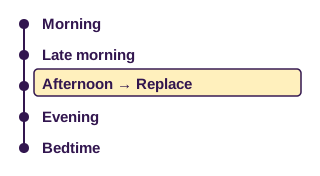
The tool lets a player replace an individual event while retaining the other slots. That is a valuable distinction from repeatedly discarding the entire day until the first draw happens to feel coherent. Replacing one item lets the player ask what the sequence is missing. Perhaps every event concerns clothing, leaving little variation in action. Perhaps one event requires a second location that the imagined person has no reason to visit. The replacement can solve a specific narrative problem rather than serving as an endless search for the strangest possible card.
Read the whole combination after replacing a slot. A new event may change more than the sentence it occupies. If the person no longer carries an umbrella, a later doorway problem may lose its connection. If an early noise disappears, the final echo of that noise may no longer make sense. The app preserves the selected events when the day is saved, but it does not automatically inspect an invented narrative for continuity. That review belongs to the writer or the group discussing the sequence.
For a quick party round, one replacement may be enough. For a writing exercise, players may want to test several alternatives and keep notes about what each changes. Announce which rhythm the group is using. A person who expects a brief reveal may become restless while somebody else revises a miniature story for ten minutes. Conversely, a writer who wants to explore cause and effect should not be rushed through every interesting connection merely because the host assumes that random generation is the activity's only purpose. The same tool can support both, provided the expectation is clear.
Illustrative Scenario: a class edits the scale, not the misery
This second example is fictional and describes an offline classroom adaptation. A teacher asks small groups to arrange five mild interruptions during an imaginary school open day. The fictional character's goal is to place a paper model on a display table. One group initially connects every event through embarrassment: a squeaky shoe attracts attention, a crooked label invites laughter, and an awkward door becomes a public spectacle. The teacher notices that the activity is drifting toward an audience enjoying a person's discomfort rather than toward a comic sequence of objects and routines.
She asks the group to keep the same small events but change who or what reacts to them. The shoe squeak now matches a tiny paper bird in the model. The crooked label makes the model appear to face the wrong direction. The awkward door delays a tray of harmless craft materials, giving the character time to notice the label before the display opens. Nothing has become more dangerous or more embarrassing. The story becomes more specific because the model supplies a shared goal, and several objects now influence the same practical decision.
The group also replaces one event that requires a spilled drink with an event involving a repeating announcement. They do not want liquid near their imagined paper model. The announcement sends the character to the wrong table once, then helps them identify the correct room when its familiar phrase returns. They finish by telling the story in five short spoken sections, each connected to one selected event. A quiet student chooses to point at the corresponding object in a sketch rather than narrate. The contribution still helps listeners follow the chain.
The final discussion concerns the edits. Which event moved the character closer to the display? Which created a detour? Which repeated detail made the ending feel connected? The teacher does not ask who had the worst real school day. Students do not need to disclose an upsetting experience to provide material. Their work is a fictional sequence that can be revised. The distinction protects the activity's tone and gives the group something concrete to discuss besides whether an event sounds sufficiently unfortunate.
This case differs from Ada's solo errand in both purpose and method. The classroom group is negotiating a shared tone and a visible five-part structure; the solo story follows one character's improvisations. Neither needs to declare that adversity improves people. The useful insight is smaller: an editor can change how a mishap functions without making it disappear. An interruption can become a clue, a pause can allow a correction, and a recurring sound can connect two scenes. Those are writing choices demonstrated by the sequence, not life advice extracted from a difficult day.
Severity and chaos tell different stories
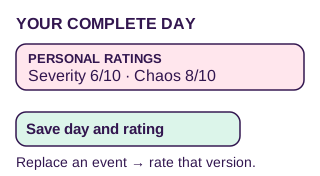
Severity asks how unpleasant the assembled events seem to the person rating them. Chaos asks how much disorder or narrative confusion the combination suggests. A low-severity day can have high chaos if five harmless events repeatedly alter a route or create a misunderstanding. A relatively simple inconvenience may feel more severe to a particular player even if it produces little confusion. The numbers are personal judgments. They should not be presented as objective measurements of hardship or used to compare the seriousness of participants' actual experiences.
When discussing ratings, name one event or connection that influenced the number. “The repeating announcement changes where the character goes twice” explains a chaos rating better than “it is very chaotic.” “The character still reaches the display comfortably” explains why severity stayed moderate. Players may disagree because they pictured different consequences, which can lead to a useful clarification of the story. They do not have to average their opinions into a supposedly correct rating. The value lies in understanding what each number describes for its author.
Avoid rewarding a player simply for interpreting every mild card as a catastrophe. If the group has agreed on small reversible inconveniences, keep that tone during the explanation. A shoelace problem need not imply an injury, and an awkward announcement need not imply a missed essential appointment. Imagination includes choosing a proportionate consequence. The host can redirect by asking what happens next inside the agreed scale. If the player wants to explore a different, more serious story, that belongs in another activity with a willing audience, not in a quiet escalation of this one.
Five events do not require five equal paragraphs
Some events deserve a scene; others work as a brief reminder. In Ada's story, the sideways pen needs enough attention to establish the address, while the breakfast mark can remain unnoticed until the ending. Equal screen slots do not require identical narrative weight. A writer can let one event cause another, combine two in the same scene, or return to an earlier detail near the close. What matters is that every selected event has a role the reader can identify, not that each receives the same number of sentences.
If the sequence feels crowded, decide which event is the hinge. This is the moment after which the character approaches the task differently. The preceding mishaps can prepare it, and the later ones can test the new approach. A hinge does not need to be a dramatic revelation. It may be the decision to ask a fellow volunteer to read the unusual address, or the choice to turn the model before carrying it through a narrow doorway. The smaller the shift, the more carefully its earlier details should prepare it.
For a mixed-age gathering, let listeners suggest one connection after the creator has described the whole day. Interrupting after every event can turn the author's sequence into a group rewrite before it has had a chance to exist. Afterward, an optional suggestion can be useful: perhaps the repeating jingle returns at the final doorway. The creator can accept, adapt, or decline it. A saved day records the selected events and ratings; it does not mean that every spoken suggestion has become part of a permanent shared story automatically.
Finish with the exact version you mean to keep
Before saving, reread the five current events. A replacement may have changed an image the player still remembers from the earlier combination. Save the version actually on screen with the ratings intended for that version, then consult local history if the exact combination matters later. If the group also writes a narrative in a separate document, label which day it develops. Do not assume that saving the event combination also saves a long spoken explanation that nobody entered into the tool.
The best finish is often a small arrival: an invitation delivered, a model placed, a character finally sitting down with an unexpectedly noisy chair. A day with a shape does not need to end by becoming perfect. It needs to leave the reader able to see how its five little problems belonged together. The tool provides the pieces and a way to revise them. The creator supplies the attention that turns a list of annoyances into a gentle comic sequence worth hearing all the way through.