The funniest moment in a category sprint is often not an impressive answer. It is the person who confidently names two kitchen objects and then offers “Tuesday” as the third. Everybody recognizes the shape of the mistake: there were plenty of possibilities somewhere, but the next one would not arrive when called. A good host lets the absurd answer become a passing joke without making the player become the joke. The clock can create a small, shared surprise. It does not need to produce a public judgment about intelligence.
Five-Second Category Sprint asks for three examples during a short countdown. That compact task contains several different activities around it: understanding the category, deciding what counts, speaking so a host can hear, and recording a valid or missed turn. Only the answer window needs to be rushed. When the surrounding decisions are rushed too, the game becomes less lively and more confusing. Its best rhythm is a clear preparation, a short burst, an ordinary ruling, and a moment to enjoy what happened before the next person begins.
The clock begins after the meaning is clear
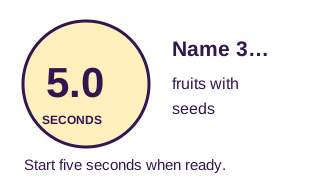
Read the whole category before choosing Start five seconds. If a phrase needs explaining, do that while the countdown is idle. A player should spend the available window finding examples rather than discovering that “things with a dial” means something different to the host. This is particularly important when a room includes younger readers or people using a less familiar language. Explaining a word is preparation for the same challenge, not a clue that secretly changes the number of required answers.
The host's ruling is also a preparation decision. Are different forms of the same thing separate examples? Can a response be a short description when its exact name is forgotten? These questions need not become a legal document. Resolve the most likely ambiguity with one unscored demonstration. If a category is “things with handles,” compare a mug, a suitcase and a door with three differently colored mugs. The difference becomes visible without spending a scored player's window on a rules debate. Keep the demonstration distinct from the actual category that player receives.
Quirky Query Hub supplies a countdown and a place for the host to record the three answers. A person still judges whether they arrived in time and fit the category. The timer does not hear the room or understand an arbitrary answer. That is a reason to keep the host position clear, not a defect to hide. A nearby observer can concentrate on the deadline while the speaker answers. If the group cannot hear a soft-spoken player, move the device or reduce surrounding conversation before asking the player to be faster or louder.
Illustrative Scenario: the picnic-table interruption
This fictional story uses a category already present in the game, “things in a picnic basket.” At a park lunch, Rowan, Evie, Jun and Marta want a short activity while two friends fetch drinks. Marta volunteers to host the first few turns. They leave a modest total-turn setting rather than promising an entire afternoon of competition. Rowan reads the category, thinks it means only food, and asks whether plates count. Marta answers that the basket can contain ordinary picnic equipment as well. Then she starts the clock.
Rowan says “sandwich, napkin, fork” with a fraction of the window remaining. Marta records the examples and awards the point. Evie, watching, says that everyone else will now have an advantage because they have heard three possible answers. Marta explains that the next turn receives its own category; this is not a shared elimination list. The explanation matters because Jun had been planning to avoid every word Rowan used. They pause to distinguish this format from Last Answer Standing before continuing. The game would feel unfair if half the table were following an invented restriction.
Jun's next category is “things that float.” He says “boat, leaf” and stops. A passing dog shakes water beside the table; everyone looks away just as Jun says “cork.” Marta is unsure whether the third answer arrived before the deadline. The timer cannot resolve what she did not hear, and replaying the moment through conflicting memories would take longer than the whole activity. She stops before entering a ruling. The table agrees to leave that disputed turn unscored and move on, applying their interruption agreement rather than awarding a point based on who argues most convincingly.
The turn changes the mood in an unexpected direction. Jun had looked embarrassed after freezing, but now offers “the dog's entire personality” as an intentionally ridiculous fourth answer after play has stopped. The table laughs at the imagined floating personality, not at his missed response. Marta does not enter it as a qualifying example. Keeping the joke outside the scoring decision lets both things happen: the rules remain intelligible and the room gets its funny moment. At the next turn they move their chairs so the host can hear clearly.
When the others return with drinks, Marta finishes the current short session rather than silently adding them midway to satisfy a bigger scoreboard. They explain the game through Rowan's completed turn and offer a fresh session if everyone wants one. Jun chooses to host next. His experience of the unclear deadline makes him careful to read before starting and watch the clock without talking over the speaker. The group has not discovered a universal policy for every interruption. It has found one workable local agreement and made it visible before the next scored attempt.
To borrow this approach, state an interruption rule before play: an outside noise or practical interruption can cancel a disputed attempt, with no claim that the browser automatically detects the problem. Decide whether the group wants a fresh turn or a move onward. Apply that convention consistently, including when the interrupted player is ahead. Avoid selectively repeating only missed attempts or preserving only successful ones. The point is to prevent the host's uncertainty from becoming a hidden advantage. If interruptions continue, choose an untimed activity instead of spending the gathering defending a five-second window.
Funny mistakes need a short shelf life
A player can enjoy one silly answer and dislike hearing it repeated for the next hour. Let the person decide whether it becomes a running joke. If someone says “toaster” for a beach category, an imaginative follow-up after the ruling might ask what a beach toaster would do. That turns an error into a new fictional object. Repeatedly announcing “here comes the toaster expert” every time the player speaks turns the person into the material instead. Hosts can redirect without a speech: use a new category, invite another contribution or simply stop repeating the label.
Avoid explaining a blank turn as proof that a player knows nothing. The game shows what was said during one short interval under one particular instruction. A spectator may easily list ten answers after hearing the category and watching someone else struggle. They had a different task and more time to prepare. Let a player supply a satisfying third example afterward if they want, without retroactively changing the result. That small separation preserves both the scored window and the ordinary pleasure of finding the word that escaped. The missed point need not swallow the conversation.
Fictional Example: the workshop that changed its pace
The second example concerns a small illustration workshop, with no noisy picnic interruption. A facilitator, Nessa, plans a sprint as a break between drawing exercises. She assumes that quick verbal play will feel easier than presenting artwork. During an unscored practice, one participant readily names three musical instruments while another, Pavel, knows what he wants to say but searches for the English names. Nessa initially considers extending the live countdown. Instead, she checks the actual tool: this game offers the fixed five-second answer challenge, not an adjustable language accommodation slider.
She gives the group a choice. They can use the browser's sprint for people who actively want that format, or run a separate untimed spoken category exercise without claiming it is the same scored game. The group chooses two voluntary browser turns, then an untimed drawing variation for everyone. During the sprint, Pavel prefers the host role. He reads the category before starting, records the spoken examples afterward and makes the announced valid-or-missed decision. His participation is useful without being presented as compensation for an inability to answer quickly.
In the drawing variation, Nessa asks everyone to sketch three impossible umbrellas. They take their time and compare the drawings without entering sprint points. Pavel contributes an umbrella that politely asks the rain to wait. The workshop ends up talking about how the same ordinary object can support verbal recall, sketching and invention. None of those tasks is declared the true measure of creativity. Nessa keeps the boundaries clear in her notes: two turns used the live tool; the drawing exercise was an independently organized activity inspired by its compact category structure.
The difference from the picnic story is deliberate. One group keeps the timed format and improves the conditions around it; the other decides that the format is not right for every part of its session. Adaptation does not always mean changing a rule until the original game disappears. It can mean choosing a different activity and saying so. If your group wants more time, a different tool or an informal untimed exercise may serve them better than a contest about whether a five-second sprint should secretly last longer for some participants.
Choosing a category without writing an ambush
A useful category gives several ordinary answers to the people actually playing. Its difficulty can come from retrieving them quickly, not from guessing a technical distinction the host has withheld. “Things that have a lid” is readable and broad. A narrow specialist category may be delightful among people sharing that interest, but it needs explicit agreement. Do not confuse a host's familiarity with general accessibility. Before a competitive session, read a sample aloud and ask whether the task is clear, rather than asking whether anyone thinks they are bad at categories.
Notice that broad wording can still produce a genuine dispute. “Foods served cold” invites questions about foods served either hot or cold. Agree whether one ordinary cold-serving context qualifies, or choose a less ambiguous category. If the disagreement appears only after a player has answered, acknowledge that the host did not settle it beforehand. Apply a fair local ruling and revise the convention for later turns. A disputed example can become interesting conversation, but the current player should not have to endure a long public debate while waiting to learn whether their point exists.
Arrange the total turns so people know the commitment. The tool's session limit gives the sprint a visible ending, which is useful between longer activities. A short session can end while energy remains. That is preferable to adding rounds until only the most competitive people still care. When people join late, choose a fresh session if comparability matters. When the group is simply warming up, explain that scores describe the recorded turns rather than equal exposure to every category. The setting needs to support the occasion, not impose a tournament on it.
Keep spectators out of the answer window
Agree that spectators save suggestions until the host has recorded the turn. A whispered hint can make it impossible to know whose three answers were heard, especially around one shared phone. This does not require a stern silence throughout the activity. It requires a small quiet space during the countdown, followed by an ordinary return to conversation. If a helper blurts an answer accidentally, apply the same previously announced interruption convention you would use for an outside noise. Do not ask the player to prove whether they would have found that word independently; nobody can reconstruct that unused version of the turn.
A fair ruling is brief and recoverable
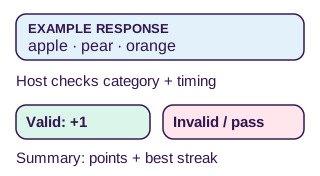
Record enough of the spoken answer to explain a decision, but do not ask the player to type during the five-second window if the intended task is spoken recall. The response field is available for the host's record. Splitting speaking and typing can accidentally turn a vocabulary game into a typing-speed game. After a valid attempt, use the award control once, then let the page move the turn onward. After a missed attempt, mark it without inventing an additional penalty. The current player prompt and turn count are there to reduce organizational effort.
If you select the wrong control, stop and use the available session management deliberately rather than improvising a compensating score on another player's turn. An exported backup is useful when stored results matter, but a casual sprint should not become a complicated accounting exercise. State the correction to the group and agree how to continue. Do not claim an unoffered per-turn editing feature exists. Sometimes the simplest fair correction is a fresh short session, especially when only one practice turn has been recorded and everybody wants to return to play.
The pause after the clock is where the host can read the room. Does the next player lean forward, or look relieved that the previous turn ended? Are people offering imaginative wrong answers voluntarily, or apologizing for every hesitation? Choose another round only if the actual group wants it. Five seconds can create an excellent little burst of attention. The surrounding minutes determine whether that attention feels like invitation or inspection. Give the clock a clear task and a clear ending, then leave enough uncounted time for people to enjoy the answers they did not expect.