A personal quiz contains an appealing contradiction. It asks people to predict something about somebody they know, then creates the possibility that the familiar answer is wrong. A favorite has changed, an ordinary habit was misunderstood, or two people remembered different moments. The surprise can be affectionate when the group treats a mismatch as new information. It becomes less enjoyable when points are used to measure who has earned a place in the relationship.
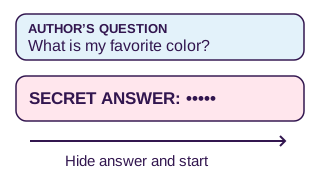
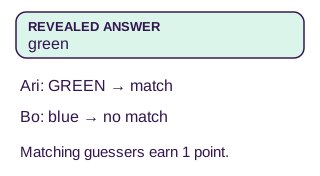
How Well Do You Know Me records a question and a secret expected answer supplied by the author. Players submit guesses before the reveal. Matching uses normalized text rather than a human interpretation of similar meanings, so wording matters. A stored correct response is a rule for a particular question. It cannot measure how attentive a friend has been across years, how close a family feels, or what somebody intended by an answer that the comparison does not accept.
The two Fictional Examples below explore that limitation productively. They are invented case studies, not real testimonials. They use custom personal questions, which are an actual feature of the activity, while their characters and events remain fictional. Their purpose is to show how a host can build a clear quiz and receive surprising guesses without making a small score carry more significance than it can support.
Fictional Example: the birthday breakfast correction
For her father's birthday, Lena plans a short quiz after breakfast. She does not want a public test of who remembers the most family facts. She asks him, Victor, to approve the subjects in advance and supply a few current answers. They choose ordinary preferences: a place to read, a weekend activity and a food he enjoys making when nobody is in a hurry. He declines one suggested question about a difficult period, and Lena removes it without asking him to justify the choice.
The food question seems easy. Most relatives associate Victor with pancakes because he used to make them every Sunday. Victor supplies omelet as the expected answer, describing it as his current favorite thing to cook slowly. Lena pauses before entering the question. Favorite food, favorite breakfast and favorite thing to cook are different questions. She writes the actual task carefully so the reveal will not pretend to settle an ambiguity she introduced herself.
During the quiz, several players still guess pancakes. They know the old routine and skim the phrase current favorite. One player enters omelette, using a different spelling. The browser's normalized text comparison does not automatically understand every equivalent spelling or synonym, so that response may not match omelet. Lena explains this limitation before the group treats the displayed points as an assessment of what each person understood.
The twist is not Victor's new preference alone. He says the pancake routine was partly a way to give the children a job measuring flour while he made breakfast. The omelet is something he now enjoys cooking quietly for himself. His relatives had remembered the most visible family ritual and assumed it remained his private preference. The quiz has shown how a shared memory can be accurate and still answer a different question from the one asked today.
Lena does not manually claim that the browser awarded a point for the alternate spelling. The displayed record follows its comparison rule. For the surrounding party discussion, the group agrees that the guess showed the intended food, and nobody needs the leaderboard to resolve their affection for one another. For a future scored round, she would choose an answer with less spelling variation or state the expected form before collecting guesses.
Victor enjoys hearing why people chose pancakes and asks whether they remember the elaborate shapes that never worked. His niece recalls a supposed giraffe that looked like a boot. The conversation moves from predicting his current preference to describing the shared ritual. That is a welcome change, but Lena distinguishes it from the quiz question already scored. They can learn something new and enjoy an old memory without revising the past to make every response correct.
The session ends after the approved questions. Victor has not been asked to disclose a secret or rate how well his relatives care for him. The guests leave with a more specific picture of a preference they thought they knew. Lena keeps the custom question only with his agreement and makes a note that favorite answers can age. The birthday activity has created a conversation, not a permanent certificate of who understands him best.
Write the question before protecting the answer
A secret answer can feel precise simply because only the author has seen it. Precision actually begins with the wording of the question. Ask whether the response concerns the present, a particular past event, a usual choice or an ideal situation. What do I order at the neighborhood café on Saturday mornings is narrower than what is my favorite drink. The narrower question gives the author a clearer task and the guessers a fairer target.
Do not make a question difficult by leaving out the relevant conditions. If somebody chooses different music for cooking and commuting, specify the setting. If their favorite changes often, use a current preference and say so. The uncertainty should concern what the players know, not whether they can discover which interpretation the author silently selected. A surprise is more satisfying when the revealed question remains recognizably the one everybody answered.
Think about text matching before choosing the subject. A short, conventional answer is easier to compare than a sentence containing optional punctuation, several names or a long description. Case-insensitive matching helps with capitalization, but it is not a promise of semantic understanding. Agree on spelling where necessary. If a question naturally needs several equally valid formulations, it may work better as an unscored conversation than as a strict typed-answer round.
Fictional Example: friends compare the present with the remembered
Rafi and his university friend June have maintained a monthly call since moving to different cities. This month they decide to make a small custom quiz for one another. They agree that each author will use three ordinary current preferences and one clearly labeled question about a shared memory. The distinction appeals to them because they often discover that a habit they still mention has been obsolete for years.
June's first question asks which object is currently kept beside her front door. Rafi guesses a sketchbook, remembering how she used to draw while waiting for friends. Her stored answer is watering can. She has started caring for plants on a narrow landing and keeps the can where she sees it before leaving. The mismatch is not evidence that Rafi ignored something she told him. She has never mentioned the landing plants during their calls.
June almost says he should have known, then realizes that the quiz is asking him to predict information he has not received. She explains the new routine and asks what he imagined when he wrote sketchbook. He says he pictured her old shared flat, complete with the stool that blocked the doorway. They have been speaking regularly while carrying mental pictures of rooms the other person no longer occupies.
Their second round concerns an explicitly shared event: the object they used as an improvised sign during a student exhibition. June enters a concise expected answer based on her memory. Rafi remembers a different object from an earlier setup attempt. Instead of arguing that the stored answer establishes the historical truth, they separate the game rule from their uncertainty. The author supplied the answer; that does not make memory immune to revision.
They decide to leave the scored round as entered and discuss both versions without awarding themselves certainty. If they want a future shared-memory question, they will choose an event whose answer both can verify privately before making it a competition. This is an adaptation to their purpose, not a requirement that every personal quiz become a research project. The present-preference questions can remain light, provided nobody presents an unknown habit as knowledge the friend ought to possess.
The most useful change comes after the game. Rafi turns his phone enough to show the narrow shelf where he now keeps his keys, after checking that nothing private is visible. June describes her landing rather than giving a tour. They do not need to exchange photographs of every corner to update the old mental pictures. A few ordinary details are enough to make future conversations feel more accurately located in their current lives.
They finish with different scores and no attempt to calculate a friendship percentage. Each can name something learned that the number does not capture: a new routine, an outdated assumption, and a distinction between a remembered fact and a plausible guess. Next month they may prefer a different game. The custom quiz has done its useful work by revealing where familiarity had quietly become a picture frozen in time.
A wrong guess can have a good reason
Invite the guesser to explain only if they want to. A response may come from an old habit, an overlooked qualifier, a practical prediction or a random choice. Hearing the reason can make the reveal more interesting, but it should not become a defense against the implication that they do not care. A host can say that the expected answer is different and then leave space for a brief explanation without announcing a failure of attention.
The author also has room to reconsider. They may discover that they answered an idealized version of the question rather than their usual behavior. Somebody who says their preferred weekend activity is hiking might actually choose a quiet morning at home most weeks. That is not necessarily dishonesty; preference and practice are different things. Clarify the distinction for another round rather than rewriting the meaning after guesses have been submitted.
Avoid retroactive traps. If the author changes their answer during the reveal, acknowledge that the target has changed. Do not treat a player as incorrect because they failed to anticipate a new decision made while listening to the guesses. A custom quiz can be flexible in the surrounding conversation while keeping each recorded round's terms clear. That makes the score easier to understand and the discussion easier to enjoy.
Choose subjects people can comfortably author
Preferences about ordinary activities are often easier starting material than private history, but no topic is automatically comfortable for everyone. Ask the quiz subject to approve questions if they concern another person. A birthday host should not collect answers from a relative and present them as the guest of honor's own declarations. A voluntary author can remove a subject without explaining why it does not belong in the gathering.
For colleagues or newer acquaintances, use information everyone had a fair chance to encounter. A question about the snack chosen during a shared workshop has a common reference; a question about someone's private home routine may not. If the goal is to learn new details, say that guesses are predictions rather than tests of existing knowledge. The framing can change the experience even when the typed answer and score remain the same.
For a pair, alternate authorship so one person does not spend the entire session being examined. For a family, consider several short subject-led rounds rather than a long quiz about the most celebrated member. The actual activity can save custom questions in a deck, but the existence of that feature does not require building a large archive. A few clear questions with time to discuss them can be more useful than a deck designed mainly to accumulate points.
Protect the private stage of the round
The author enters the expected answer before the guessing stage. Keep that screen private until the answer is hidden. Demonstrate the sequence with an invented sample if people are uncertain about when to pass the device. If someone accidentally sees the answer, replace the question rather than making them prove they can ignore what they saw. An ordinary procedural repair is kinder and more reliable than suspicion about an accidental glance.
Allow each eligible guesser to submit before the reveal. Do not announce a correct guess early, react visibly to the first answer, or ask someone to show their response to the whole room. The interface can protect the stored answer from appearing prematurely, but the host's expression can still provide information. Neutral reading and ordinary handoffs keep the uncertainty focused on the question rather than on deciphering the author's reactions.
Custom questions and browser backups can contain personal material. Agree on whether the author wants them retained, exported or removed after play. A local-only record is still a record on a device someone may share. Do not promise that downloading a backup makes private answers harmless to circulate. The activity does not require posting the results or preserving the guesses to make a short gathering worthwhile.
Let knowledge stay capable of changing
A person is not a fixed answer sheet. A useful personal quiz makes that obvious without using change as an excuse for unfair questions. Specify the conditions, keep the response clear, and receive mismatches as information with a limited scope. The recorded point belongs to the match rule. The more interesting result may be the question somebody asks after realizing they have been imagining an old room, routine or favorite.
When you finish, ask what you would want to update before playing again, rather than who scored well enough to deserve another invitation. Perhaps the question needs a time word, perhaps an answer needs simpler spelling, or perhaps a good subject would work better without points. Those are practical improvements the group can make together. Familiarity becomes more useful when it leaves room to learn the person standing in front of you today.