A category can look enormous until other people begin using it. At the opening of Last Answer Standing, “things with wheels” seems almost generous. A few turns later, the obvious vehicles have gone, someone has claimed a shopping trolley, and the next player realizes that remembering earlier answers is now part of finding a new one. The field has not changed on the screen, but the available territory has. That gradual narrowing gives an elimination game a different character from a series of independent quick questions.
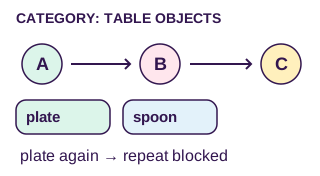
The accepted list is therefore more than a scoreboard decoration. It is the shared history of what the room has already contributed. A good round lets people inspect it and makes the boundary of the category understandable. The host deals with meanings and disputed examples; the browser can reject normalized textual repeats, track errors and show who remains. Neither the list nor the error count can decide every question about language. The interesting hosting work is to keep those human judgments consistent as the familiar answers run out.
The opening agreement lasts longer than the opening answers
Define the level of detail before competition. Are two kinds of bicycle different answers, or is bicycle one answer family? Are fictional vehicles allowed? A broad category can sustain a long round, but only if the players share a broad understanding of it. You need not predict every odd response. Establish enough through a short unscored comparison that a late ruling follows an existing principle rather than the host's preference for a particular player. A room can accept an unfamiliar word more easily when it understands the reason it qualifies.
The game's custom category and errors-before-elimination setting give a host useful preparation choices. A greater error allowance changes how quickly someone leaves the active rotation; it does not make the app a semantic dictionary. Use the allowed range shown in setup and apply the options before starting. Explain whether a rejected repeat leads to a recorded failed turn under your agreement. The browser rejects the duplicate text; the host still chooses the error control when the player cannot provide a qualifying fresh answer. Those are related decisions, not one invisible automatic judgment.
Fictional Example: the suitcase category
This illustrative story describes a custom-category round at a family visit. Four cousins are waiting for a repaired train connection, with an adult relative acting as host. They are seated safely in a quiet lounge, not trying to handle a device while moving through a station. To match the occasion, they choose “ordinary things packed for an overnight visit.” The host states that distinct purposes count, while colors and brands do not. They choose two errors before elimination because the younger players want room to recover from a mistake.
The first circuit is easy: toothbrush, pajamas, charger and socks. On the second circuit, Sana enters “phone charger.” The browser does not need to decide whether that is the same purpose as charger; the people can see the earlier entry and discuss it. Their opening agreement leads them to treat both as the same item family. Sana still has a chance to offer another idea before the host records a failed turn under their chosen convention. She says “book,” and the accepted list grows. Nobody calls the app broken for not understanding their personal synonym rule.
Several turns later, Ellis submits “pillow.” A cousin objects that an overnight visitor would use the host's pillow. Ellis explains that he takes a familiar small pillow when staying elsewhere. The category did not require every person to pack the same item, only an ordinary plausible example. The host accepts it. The objection is resolved by returning to the words of the category, not by asking the majority to vote on Ellis's habits. This matters because a popularity ruling would penalize the person whose ordinary experience differs from the others.
The turn becomes funny when another cousin suggests “the permission slip for borrowing the pillow.” Everybody begins inventing increasingly elaborate pillow paperwork. The host enjoys the joke but stops the turn timer before the discussion grows. When play resumes, paperwork is not quietly entered as a new qualifying item. They distinguish the actual accepted answer from the free conversation around it. The group gets to be silly without losing its shared list. Ellis, who had looked defensive about his pillow, now designs a fictional stamp for its imaginary travel permit.
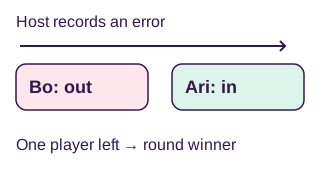
Near the end, only Sana and Ellis remain. Sana offers “medication,” then immediately says she does not want to discuss anyone's actual health. The host accepts the general item without asking what a player takes. Ellis cannot find a new answer and records the final failed turn. Sana is the last remaining player. They finish the round before the train announcement, congratulate the result and compare their most unexpected accepted item. No one suggests that the winner is better prepared for real travel; the outcome belongs to this invented list and its sequence of turns.
The case shows how a category can include different ordinary lives without requiring personal disclosure. Ellis need not prove that he packs a pillow, and Sana need not explain medication. In your own custom category, separate plausible examples from autobiographical evidence. A player can supply an example without owning the item. If a subject starts drawing private questions, move back to the general category or select another one. The game needs a fresh word, not a justification of a person's home, income, body or family arrangements.
What a repeat checker can and cannot know
Text normalization is useful because capitalization and punctuation should not create extra answers. APPLE and apple are not two new contributions merely because they look different when typed. Meaning is harder. “Bike” and “bicycle” may refer to the same item, while “crane” can name very different things. The host should interpret an answer in the stated category, asking for a short clarification before accepting it if needed. Do not assume that a technically distinct string establishes a legitimately distinct idea. Equally, do not assume two similar words describe the same thing without listening.
The public list helps make these calls discussable. Read the earlier entry, restate the new proposed meaning and apply the same convention used before. A host can say, “We are treating subtypes as one family in this round,” without declaring that the words are universally identical. That modest wording avoids turning a local game rule into a claim about language. If the group wants finer distinctions, choose that scope for the next round. Altering the granularity halfway through because one player has specialist knowledge changes the competition after people have already spent their turns.
Illustrative Scenario: a club learns to reverse a ruling
In a separate fictional case, a small model-making club chooses “things with wheels” from its available category material. They agree to allow distinct objects rather than separate brands of the same object. The first accepted answers include car, wheelbarrow, skateboard and office chair. Their host, Tomas, expects a short friendly contest. The group knows one another's interests, which is helpful until Tomas begins assuming he knows what every proposed answer means. That familiarity becomes the source of the disputed move.
On her turn, Leila enters “pottery wheel.” Tomas hears only “wheel” and records an error, thinking she has named a component rather than an object. Under their selected allowance it eliminates her. Leila explains that she means the rotating work surface used by a potter. The others recognize it as a distinct object that fits their broad wording. Tomas does not give the next player a bonus point to compensate, nor tell Leila she should have explained faster. He stops and uses Undo last move to restore the previous state before continuing with the agreed correction.
Undo is useful here because the error is identifiable and the group has not built several later decisions on it. After restoring, they inspect the current turn and remaining-player information rather than assuming the button reversed exactly what they remember. Tomas then handles the clarified answer under the existing convention. He also changes his hosting habit: when an unfamiliar phrase might fit, he asks what it means before entering a failure. A later player offers “spinning wheel,” and the group checks its meaning without automatically accepting it because it resembles Leila's answer.
The round ends with Tomas out of the running and still acting as recorder. Leila does not win, which makes the correction less easily remembered as a favor to a winner. She stays involved long enough to contribute several fresh examples and enjoys hearing another member explain a wheeled suitcase that opens into a chair. The club's next round uses “objects moved by a person” as a different category, with its own discussion about what qualifies. They do not silently edit the previous category and pretend its rules always meant the new wording.
The practical distinction is between a reversal and an exception. Undo corrects an erroneous recorded move; it should not become a way to rescue whichever player the host wants to keep. When you reverse a ruling, state what was misunderstood and which existing rule now applies. If the dispute remains unresolved, agree on a neutral way to restart or choose another category. A tool can restore a prior state more reliably than a group can restore trust after unexplained favoritism. Make the reason visible before the next timer begins.
Elimination should change the turn, not erase the person
An eliminated player may enjoy watching the remaining possibilities narrow. They may also prefer something useful to do. Offer the recorder role, reading the accepted list or checking that the next active player has the device. These are optional contributions, not punishments disguised as jobs. Do not allow a recorder to feed answers to a favorite remaining player. A supporting role needs a clear boundary so the active contest continues to mean what the group agreed. People should know whether they are helping organize the round or jointly answering it.
For a group where waiting feels unpleasant, choose a shorter category, a smaller session or a different format next time. Increasing the error allowance can soften early elimination, but it may also lengthen the finish. The right choice depends on whether people enjoy the narrowing contest or mainly want to keep contributing words. There is no obligation to turn every vocabulary activity into elimination. A cooperative list built on paper is a legitimate separate activity, provided you do not label its shared result as a browser victory the tool never recorded.
The player order creates its own texture. Later players hear earlier answers but lose access to them. Early players have a wide field but less time to learn how the host interprets the category. Rotate the opening player across rounds if the group cares about repeated comparisons. Avoid claiming a perfect mathematical balance; different categories have different familiar examples. The useful goal is an arrangement people understand and want to repeat, not a proof that every turn in a social word game has identical difficulty.
The narrow end of the list
As answers become less obvious, the host faces a temptation to accept anything merely to keep play moving. That can undo the value of the earlier careful rulings. Give an unusual answer a fair explanation, but keep the original boundary. A creative association belongs in the conversation even when it does not qualify as a fresh category item. Someone proposing “a wheel of cheese” in an object-with-wheels round may have made a good joke about a word. They have not necessarily named an object containing wheels under the group's chosen definition.
The opposite temptation is to become stricter because the final two players are close. Do not suddenly demand technical vocabulary or reject descriptions that were accepted at the opening. The last turns should be difficult because the accepted list is long, not because the host adds new conditions. If a category genuinely runs out for everyone, discuss what the group wants to do rather than implying that an automatic tiebreaker exists when it does not. A fresh category can provide another contest, but it is a new decision shared by the people present.
After the final result, ask for one answer somebody almost used and one accepted answer that surprised them. Those two questions recover the invisible part of the round: ideas that were forming and knowledge that entered through another person. They also let an eliminated player contribute again without changing the recorded outcome. Do not demand that the winner demonstrate expertise outside the game. The list is an artifact of one sequence of opportunities, interruptions and conventions. Its charm lies partly in how different another round could become with the same people.
Leave a category worth returning to
If you save a custom category for future use, note the ordinary boundary that made it work: general object families, familiar examples, descriptions allowed when names are forgotten. Keep that note separate from a claim that the software automatically enforces every semantic choice. The visible setup can preserve game options, while your group still needs to hear the human convention. A category is reusable when another host can explain it plainly. If it needs a long account of exceptions from last time, simplify it before reopening the contest.
Finish while the accepted list still feels like something the group made together. There may be obscure answers left that no one cares to excavate, and stopping is allowed. A well-hosted elimination round has room for a missed word, a corrected mistake, a funny misunderstanding and a clear result. Its useful tension is that every contribution makes the next turn different. Protect that tension with consistent boundaries and let the people remain larger than the score. The last answer matters because of the answers before it, not because it proves who knows the most.