Most Likely To begins with a prediction, but its best moments often involve revision. A familiar group thinks it knows who would do something. Then the votes divide, a reason appears, and a person discovers that other people have noticed a quality they had not thought to name. The activity becomes interesting when the nomination concerns an imaginable action, rather than a verdict about someone's entire character.
That distinction changes the tone of the room. Most likely to organize a parade for a missing button is a fictional task with several plausible candidates. Most likely to be a disappointment is an insult wearing a voting rule. A host does not need to preserve every possible prompt in the name of fairness. Choosing kind, specific actions gives the group something to compare without making a person defend their worth against a tally.
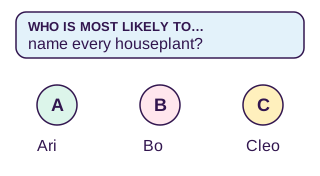
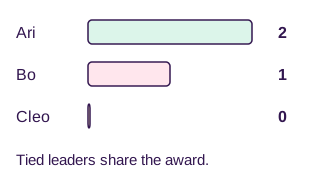
The following Illustrative Scenarios are fictional. Their invented nomination subjects are spoken examples used to discuss hosting, not claims that those exact prompts occur in the live bank. The browser manages real voters selecting names from the roster, reveals the tally, and credits tied leaders. It does not discover objective truths about people. The reasons supplied around a vote are the contribution of the players, not an automatic interpretation of the result.
Illustrative Scenario: the museum of lost objects
Seven friends have volunteered to help clear a rehearsal space before its lease ends. Their reward is a takeaway dinner at a table surrounded by boxes of props. The objects are strange enough to invite a game: a wooden pear, a crown with one missing jewel, and a bell nobody remembers using. Jules suggests a few friendly nominations after the food has been served, when people can sit and stop carrying things.
For a spoken warm-up, the group imagines which friend would be most likely to establish a museum for all the unidentified props. Several expect Arun, who usually remembers dates and production titles. Bea receives three votes, Arun receives three, and Kit receives one. Jules reads the split as a useful difference rather than a failure to find the correct person. He asks one volunteer from each group to explain the particular museum they imagined.
Arun's supporters pictured labeled shelves, an inventory and opening hours. Bea's supporters pictured visitors entering an elaborate story about a pear that had once ruled a kingdom. Kit's voter pictured someone finding a building cheaply enough that the museum could exist at all. The same nomination has generated three different jobs: preserving, interpreting and making space. None of the explanations requires the other nominations to be foolish.
Arun admits he would probably build the inventory and then never open the doors. Bea says she would love inventing exhibits but would forget the addresses on the invitations. Kit suggests that their imaginary museum needs a team. The group laughs at the practical organization of a project that will never happen. The nomination has become a way of recognizing contributions rather than sorting people into a single hierarchy of competence.
The next turn happens in the actual browser activity. The friends enter recognizable names, read the displayed prompt and pass the device for each eligible vote. Jules does not use his hosting role to enter everyone's choice based on the conversation. Someone who sounded enthusiastic about one candidate may choose another in private. Waiting for the submitted tally preserves the difference between an audible opinion and the vote that actually counted.
An unexpected result gives Kit a shared lead on a generated nomination. Bea begins to explain why Kit is too quiet for the imagined action, then remembers the museum discussion. She asks which version the voters pictured. One friend mentions the time Kit solved a mundane booking problem without announcing it. Kit says he would rather not become the designated fixer for every future outing, but he appreciates that the small effort was noticed.
Jules accepts the limit immediately. He does not turn the award into a job assignment or ask Kit to promise another rescue. The app credits the tied leaders according to its rule, and the friends continue. Their imaginary museum disappears when the last boxes are packed, but they leave with a more varied picture of how each person contributed. A playful prediction made room for recognition without creating a contract.
Why the explanation should describe an action
An action-based reason can remain modest: I imagined you designing the entrance sign because you notice what visitors see first. A character-based verdict expands quickly: you are always the creative one, and nobody else can do that. The first describes why a nomination made sense in a fictional situation. The second can trap somebody in a role and make the other players sound less capable by comparison.
Invite reasons that are kind and specific, but do not require a public anecdote from every voter. Some people will choose because of a conversation the rest of the group does not know, and they may not want to retell it. A short explanation about the imagined action is sufficient. Do not demand proof that a nomination was legitimate. The game is a local judgment about a playful premise, not a tribunal reviewing a reputation.
Keep the nominated person's response optional. They may enjoy expanding the fantasy, correcting a small assumption, or simply smiling while the next round begins. Winning a vote does not obligate them to perform the nominated task. That matters even when the task sounds flattering. Being named most likely to host everyone for dinner can feel like being handed an unpaid job if the group starts treating the result as a practical plan.
Illustrative Scenario: a club welcomes its newest member
A small model-making club has finished a Saturday workshop. Four established members and two newcomers stay to clean up the room. The workshop leader, Danica, wants a short social activity that does not require anyone to explain their occupation or personal life. She considers Most Likely To, then notices the obvious difficulty: the established members have years of shared anecdotes and the newcomers have been present for only an afternoon.
She does not pretend the familiarity difference is irrelevant. Before opening the browser, she offers a spoken practice nomination based entirely on the workshop they all just attended: who would be most likely to design a miniature station for a train no bigger than a fingernail? She asks everyone to imagine the design rather than nominate the person with the most advanced equipment. The premise gives the newcomers observable material from the shared afternoon.
One newcomer, Sol, receives several votes after making an unusually small ticket window during the workshop. An established member, Peter, receives votes for a carefully planned platform. Danica asks what detail each group imagined first. Sol says his station would have an enormous timetable because he likes the disproportion. Peter says he pictured passengers trying to read it with a magnifying glass. Their explanations begin a conversation between people who had barely spoken before cleanup.
The turn changes when an old member nominates Peter for the next spoken subject using a joke nobody else understands. The joke is affectionate, but it makes the newcomers spectators to a private archive. Danica does not ask the club to explain years of history. She suggests returning to a subject everyone can picture from today's session. The old joke can remain part of their friendship without becoming the entry fee for joining the activity.
They use the browser for a few generated prompts, checking each one before collecting votes. Where a nomination would depend on private familiarity, they skip to a more suitable round rather than manufacturing knowledge of Sol or the other newcomer. Danica explains that changing the prompt is a hosting choice, not an error the interface must resolve. The tool can count names accurately even when the room lacks a fair basis for choosing among them.
At the end, Sol has one shared award and Peter has two. Nobody interprets the difference as a measure of how well they belong in the club. Danica asks what kind of project people want to try next month and hears the newcomers' ideas directly, without using the leaderboard to decide who gets to speak. The game has provided a bridge into conversation; it has not become the club's method for allocating influence.
Familiarity is material, not a requirement to expose history
This game often suits people who know one another because nomination relies on a picture of the candidates. That does not mean it must exclude newcomers. It means the host should choose a common frame. A shared workshop, a fictional mission, or a current activity can provide observable details. If the room cannot find that frame comfortably, begin with an A/B choice or a collaborative story instead of making people guess at personalities.
Avoid using the activity to introduce someone through a stack of old labels. A new visitor may learn that a friend is always late, always loses things or always complains before they have a chance to meet that person in the present. Even when the group regards the label affectionately, its repetition can make a narrow role sound official. Prefer a prompt that creates a fresh scene where several people could contribute in different ways.
The current roster should contain only people genuinely participating. Nominating an absent colleague can slide into speculation the person cannot respond to, and adding their name makes the tally look like a game they joined. A host can discuss fictional characters in a clearly separate spoken variation, but should not confuse that adaptation with votes by actual absent people. The browser's numbers are only as honest as the participation entered into them.
What a tie can show
A tie is not always a problem to eliminate. Two candidates may represent different routes to the same action, as Bea and Arun did with the museum. Let the shared result remain visible long enough to compare those routes. If the interface credits every tied leader, describe that rule before play. A sudden invented tie-breaker can change the meaning of the round after people have already submitted their choices.
Ask what would happen if the tied candidates worked together. This can develop the fictional premise without declaring that the people must collaborate in real life. One might plan while another improvises; they might disagree about the very purpose of the project. The resulting story belongs to the imagined task. Keep a clear boundary between enjoying that picture and making a serious assessment of how the friends would perform under actual responsibility.
If the group prefers a faster pace, invite one sentence about each leading candidate and continue. Not every shared result needs a workshop in team roles. The point of allowing ties is to preserve an honest outcome, not to turn every ballot into a lengthy interpretation. Some rounds deserve only a laugh, and some unexpectedly supply a reason to talk for another few minutes.
Keeping the ballot independent
Read the full nomination before the first voter chooses. Avoid announcing the obvious candidate, even as a joke, because it gives everyone a ready answer to imitate. Follow the current-voter sequence and pass the device as directed. In a public-tally setting, explain that people may see responses as they arrive; if the group wants less social influence, use the available private approach and wait for the reveal rather than narrating interim choices.
Do not cast a vote for someone who has stepped away. Wait, agree to move on, or manage the roster through the actual controls. A host guessing what they would have chosen creates a misleading sense of unanimity. Similarly, let a voter take a moment without explaining their hesitation aloud. Their pause may concern the fictional scenario, not an uncomfortable opinion about the people on screen.
After the reveal, report the result accurately. The group chose a leader in this round under this prompt. Do not translate four votes into everybody thinks, or a low tally into nobody sees that quality in you. The selected action may have been interpreted in a way that favored a particular candidate. A small amount of precision protects the game from becoming a more powerful statement than its evidence supports.
An ending that leaves room for change
A friendly nomination can make an unnoticed contribution visible. It can also reveal that a group has been using an old description long after the person has changed. A host does not have to settle which interpretation is correct. Offer the nominee room to respond, keep the fiction concrete, and let the next prompt present a different task. Variety prevents one award from hardening into a permanent assignment.
When the session ends, keep any shared joke proportionate to the occasion. The museum committee can remain an imaginary committee; the miniature station can remain a conversation about design. What lasts need not be the leaderboard. It may be the moment somebody asked what version of the action another voter had imagined, and discovered a new reason for an old friend to receive a very unexpected award.
Recognition should not become recruitment
After a flattering result, notice whether the room begins assigning real work. Naming somebody most likely to plan an imaginary expedition does not make them responsible for the next actual holiday. Separate appreciation from a request. If the group does want their help, ask later in an ordinary conversation where they can discuss time and decline without contradicting a public award.
The same distinction protects the person who receives few votes. They have not been excused from friendship or ranked below the leaders as a contributor. The prompt selected one invented action, and the ballot captured the room's first interpretation of it. A different scenario can reveal a different strength, but you do not need to manufacture an award for everyone to explain why nobody's value is being measured by this leaderboard.