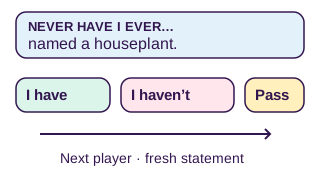
A person can describe an event as too ordinary to mention and still remember its exact weather, the sound of a door, or what somebody said afterward. Never Have I Ever gives that overlooked material a simple entrance. A statement names an experience; a player says whether it applies. The answer can be complete on its own, or it can open a story nobody would have introduced with an invitation to say something interesting about themselves.
The activity works best when having done something and not having done it are equally acceptable positions. An unfamiliar experience is not a missing achievement. A shared experience is not proof that two people had the same life. The browser records responses under the selected points or lives rule. It cannot determine what an event meant to somebody, whether they want to discuss it, or whose version of a memory should become official.
The two stories here are explicitly Fictional Examples. They explore different uses of an experience prompt: a gathering where a modest memory grows unexpectedly, and a conversation where a negative answer becomes the useful part. Invented statements in these scenes are paper or spoken discussion examples, not assertions that the exact wording appears in the live bank. Use the methods with the real statement your session displays.
Fictional Example: the box nobody had unpacked
During the last afternoon of a small neighborhood book exchange, three volunteers are folding tables while waiting for the person with the storage-room key. Alma has spent the day recommending novels. Priya has been matching lost scarves with their owners. Denis has carried so many boxes that he would prefer a question requiring no opinion about literature. Alma opens Never Have I Ever and suggests a few turns before they finish.
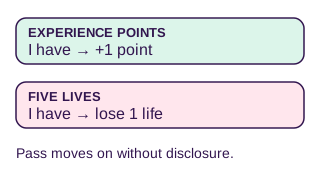
They choose experience points and explain the direction before answering: an admission earns a game point, without making the admitted experience admirable. Their first generated statement leads to a brief response and no story. Alma moves on naturally. That ordinary transition matters. It shows that participation does not require finding a funny account to justify every button press. Nobody has signed up for a contest in autobiography.
For a separate spoken round, Priya suggests an invented statement about keeping an unopened moving box for more than a year. Denis admits he has one containing kitchen things. Alma expects an account of forgotten utensils. Instead, Denis says the box was packed by his former flatmate, who labeled everything with terrible puns. He remembers one marked Thyme Capsule and realizes he has been keeping the sealed box partly because the label still makes him smile.
Priya asks whether he wants to open it now, and then catches herself. They are waiting in a community hall, not standing beside the box; more importantly, he has told a memory rather than asked the group to solve a problem. She changes her question to which label he can still remember. Denis describes a box of mugs called Handle With Confidence. Alma remembers a neighbor who drew pictures instead of writing labels, including an alarming cartoon for a box of knives.
The discussion turns when Alma says that unopened boxes are always a sign of procrastination. Denis does not argue, but his expression changes. Priya returns to the actual detail: this particular box includes a reminder of a friendship. Alma revises her comment without making the moment dramatic. She says she had imagined a box of cables, which was not the box he described. They have discovered that the same external event can carry different reasons.
They finish the spoken example and return to the browser, where each current player gets the displayed statement and can choose I have, I haven't, or pass as the interface allows. They do not enter the invented moving-box prompt as if it were a generated card. The score continues to record actual submitted responses, while the conversation around it remains optional. That separation keeps the interface from pretending to document everything said at the table.
When the key arrives, Denis takes a photo of an unrelated book-exchange sign because its pun reminds him of the old labels. He does not promise to unpack the box that night. Priya does not assign him a task. The activity ends with a small new detail about a person they had mainly known as the volunteer who carried things. The story became memorable because it was allowed to remain his, including its unfinished part.
What the unfinished box teaches a host
The useful follow-up stayed close to what the speaker offered. Asking which label Denis remembered developed the account he wanted to tell. Asking why he had never unpacked the box might have turned it into a request for an explanation he had not offered. A host can listen for the difference between an interesting detail and an apparent problem. Not every mention of an unfinished task is a request for advice.
An experience statement can also reveal a classification mistake. Alma began by interpreting unopened boxes through her own familiar explanation. The correction was not that procrastination never exists. It was that one person's answer did not supply enough information for that conclusion. If a prompt produces a surprising admission, invite the person to add context before the group writes the rest of the story on their behalf.
Nobody needed to make the exchange a lesson about their deepest relationships. A cheerful label and an unhurried question were sufficient. The host's practical skill was preserving that scale. Some stories become serious; many remain small. An activity can respect both without insisting that ordinary memories reveal a hidden truth whenever a player pauses to think.
When the answer is I haven't
An experience game can accidentally make the negative answer feel like an empty space. If every follow-up goes to somebody who has done the thing, other players become an audience waiting to qualify. Give a negative answer its own possible direction. A player might describe what they imagined, ask a practical question, or say they would prefer never to try it. They may also simply pass the device and listen.
Keep those options distinct from pressure to acquire the experience. Somebody who has never hosted a large dinner does not need a plan for doing so next weekend. They may enjoy hearing how another person managed the chairs. An invitation to imagine a version can be useful, but it should not imply that the original answer is incomplete. Curiosity can travel in both directions without turning the game into a list of things to accomplish.
Fictional Example: the reunion of the unfinished orchestra
At a reunion for a former amateur music class, five adults discover they remember different parts of the same term. Tessa recalls the final concert as a success. Mark remembers a broken music stand. Ivo remembers rehearsals mostly through the bus journeys afterward. Their old tutor, now attending as a guest rather than running a lesson, suggests a short experience game while they wait for food. They choose ordinary themes instead of testing who practiced most.
A spoken statement asks whether anyone has continued humming the wrong tune after the music stopped. Tessa admits it immediately. Mark says he has not, then adds that he never knew which tune was supposed to be correct. Everybody laughs, including Mark, but Tessa notices that he is describing a real difference in how he experienced the class. She asks what he followed when the notation stopped making sense.
Mark says he listened for the percussion pattern and watched when other people breathed. Ivo realizes that the person he considered the confident player had been using a set of practical cues. He had imagined confidence as knowing all the notes. The negative answer has opened a story about participation rather than musical accomplishment. Mark says he liked belonging to a group that could make one sound together, even when his own contribution was hesitant.
The turn becomes awkward when another guest proposes voting on who had been the worst musician. The tutor declines the new frame without explaining Mark's feelings for him. She says this activity concerns experiences, not a ranking of their old classmates. She offers a different question about an amusing rehearsal interruption. Mark volunteers an account of a dog outside the window, and the conversation moves to something he is happy to describe.
They later use the browser to run several ordinary experience turns, taking the current-player sequence seriously rather than answering for absent classmates. A player who wants to leave an experience unexplained presses the appropriate response and hands over the device. They do not award extra browser points for the longest story. The selected mode records an experience response; narration is part of the surrounding gathering and does not need to become a separate competitive category.
By the time food arrives, their shared memory of the term is less tidy and more enjoyable. The concert was successful for Tessa, demanding for Mark, and connected to friendship for Ivo. Nobody needs a final agreement about what the class was really like. They decide to find the old recording another day if everyone wants to hear it, rather than making listening compulsory at the table. The evening has room for several recollections of the same place.
A score is a convention, not a verdict
Explain the chosen scoring mode before the first personal answer. Experience points make one response add a point; the lives mode gives an admission a different game consequence. A player should not discover the direction only after answering. If the rule is unclear, pause before collecting more responses and demonstrate it with a harmless fictional sample. The purpose is clarity, not rewarding one kind of life over another.
The browser rotates turns and statements, which can differ from a paper gathering where everyone answers the same sentence at once. Say which version you are using. A host can discuss one displayed statement with the room, but should not describe a single entered answer as a vote from every person. When the next player receives a new prompt, follow that sequence or explicitly take a conversational break outside the recorded turn.
Do not compare final scores as quantities of courage, curiosity, or experience in general. The result depends on which statements appeared, who answered, and what the mode records. A cautious person can have a high score on ordinary mishaps; an adventurous person can have a low score in an unfamiliar theme. The tally is a trace of a selected game, with no authority to define the people who played it.
Giving memory a little space without conducting an interview
A simple follow-up can ask where the scene began, what surprised the speaker, or which harmless detail they remember most clearly. Choose one that fits the account already offered. If somebody mentions a train delay, they may enjoy describing the improvised picnic and prefer not to discuss why the journey mattered. The host does not need the entire background to receive the story with interest.
Let people correct themselves. Memory can arrive in fragments: perhaps the incident happened at a different station, or the friend carrying the bag was somebody else. Unless the correction changes the game response, there is no reason to turn uncertainty into a challenge. If two people remember the event differently, ask whether both versions can be heard as recollections rather than appointing the table to determine whose memory is admissible.
Keep other people's privacy out of the price of a good anecdote. A player can replace a name with a role, omit a workplace, or stop before the part involving someone who is not there. Do not ask to see messages or photographs as proof. An experience game has no need for an evidence hearing. If a story starts depending on another person's private difficulty, offer a new prompt rather than requesting a more entertaining explanation.
Adapting the activity to the room
For a mixed-age gathering, choose experiences that people can understand without having had the same opportunities. Public transport, household mix-ups, hobbies, and small surprises can provide several entry points. Even familiar topics can contain differences: one child may never have used a train, while an adult may never have cooked a particular meal. Treat those differences as context, not a gap somebody must excuse.
For people who know each other well, resist anticipating the answer. A sibling may have a story the family never heard; a friend may no longer want to repeat an old anecdote everybody expects. Ask about the current response rather than announcing the famous incident before the person speaks. Familiarity is useful when it supports an offered story and intrusive when it substitutes a public script for the player's choice.
For a brief activity, announce that explanations are optional and keep the first story short yourself. This gives a realistic example of how much the session can hold. If someone starts an absorbing account, let the group choose whether to listen longer or return to the game. Finishing fewer prompts with attention is more useful than checking off statements while the person speaking notices everyone looking toward the next card.
At the end, allow the memories to remain ordinary. A mislabeled box can stay unopened; a reunion can hold several versions of a concert. Never Have I Ever is valuable because it offers an entrance to stories, not because it resolves them. When the next person receives a fresh statement, they should be free to answer at their own scale, from a simple button press to a detail the group will remember later.
A theme should widen the entrance
If several players repeatedly answer negatively, look at the theme before assuming the room lacks stories. A narrow travel theme may depend on opportunities some people never had, while an ordinary mix-up can invite contributions from more directions. Offer another theme as a change of material, not a rescue for supposedly inexperienced players. Those who enjoyed listening may already be participating in exactly the way they prefer; ask about the next format without assigning them a problem to solve.