A strange riddle invites a particular kind of attention. A perfectly ordinary sentence creates an apparently impossible scene, and the listener begins filling its gaps. A race must have competitors. A sign must be giving an instruction. A room full of working clocks must tell someone the time. The puzzle becomes interesting when one of those additions turns out to belong to the listener rather than the sentence. The best reveal changes the interpretation of the scene without changing the evidence the group was given.
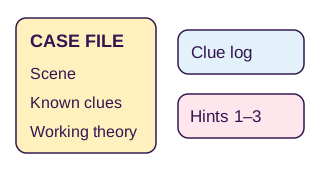
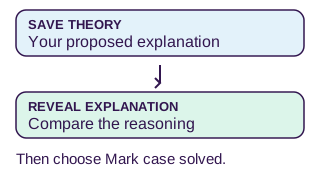
That distinction separates an enjoyable investigation from a frustrating trick. If the answer requires a fact nobody could reasonably infer, the host can always defeat the players by adding something new. A detective game becomes more satisfying when investigators can ask questions, examine assumptions and follow hints toward a coherent explanation. Quirky Query Hub offers a record of host replies, progressive hints and an explanation reveal. Those tools organize the inquiry. A human host still decides how a question relates to the solution and whether the group's reasoning counts as a solve.
Start by hearing the sentence that was actually read
Read a new riddle once without commentary, then invite someone to retell only its stated events. A retelling often introduces a useful discrepancy. The sentence says somebody finished ahead of everyone; the retelling says somebody won a race. Those are not identical claims. Do not immediately announce the hidden assumption if noticing it is the point of the puzzle. Ask which words establish the claim. That small question allows the investigators to make the discovery rather than merely receive a host's explanation of why they were fooled.
The host should read the stored solution privately before inviting questions. Otherwise an apparently helpful answer can contradict the intended explanation and make the remaining inquiry unfair. Keep the host solution out of view during device handoff. The participants need the public mystery and question record, not a glimpse of the secret followed by an instruction to forget it. If an accidental reveal happens, choose another puzzle or discuss this one openly as a construction exercise. Pretending the answer remains unknown creates a competition about acting surprised rather than reasoning.
Fictional Example: the welcome-desk sign
This illustrative story uses the game's sign-shop riddle, whose explanation is that the CLOSED sign is merchandise rather than an announcement about the shop. The surrounding gathering is fictional. A volunteer team is preparing a local craft fair in a library meeting room. Their coordinator, Idris, wants a short shared problem after an afternoon of practical instructions. He selects a riddle session, reads the host solution privately and tells the group they can ask questions before requesting a hint. Nobody has to guess immediately.
The prompt describes customers entering a shop despite a large CLOSED sign. Rosa decides the sign must be facing backward. Ken thinks the customers are employees. Ana suspects the shop has reopened but forgotten to remove yesterday's notice. Idris records their questions and replies according to the actual solution, declining to turn each guess into a long explanation. The group discovers that the customers can read the word and are genuinely welcome. This makes Ana feel that the host is withholding a trivial detail: perhaps the shop simply ignores its own sign.
Instead of demanding the answer, she asks what they have assumed the sign is for. The wording does not say it was hung on the entrance to announce opening hours. That observation changes the investigation. Ken asks whether the sign is being sold. Idris answers Yes. Rosa proposes a sign shop, and the group asks to reveal the explanation. They have moved from inventing an unusual failure of communication to identifying a different purpose for a familiar object. The scene no longer needs customers to disregard an instruction, because there was no instruction addressed to them.
The entertaining turn comes after the solve. Several volunteers have spent the day debating the fair's own signs. Rosa picks up a sample card reading SOLD OUT and jokes that their display of signage has already failed as a shop. Idris lets the group enjoy the connection, but does not claim their practical planning disagreement has been diagnosed by a riddle. They discuss one modest useful question: who is the reader of a particular sign, and what action is it asking for? A puzzle about merchandise can prompt that question without establishing a grand theory of communication.
When Idris acknowledges the solve, he uses Mark case solved once. He does not award extra points for the funniest afterthought or silently remove points from the first incorrect guess. The group then stops because the volunteer briefing must resume. Their result is one completed investigation with a clear turning point. For another host, the reproducible method is to collect alternative interpretations before arguing about them. It is not to repeat the same sign-shop answer whenever a room needs a lesson about assumptions. The discovery works because it was not known in advance.
A hint should preserve a decision for the investigators
There is a difference between a hint and an answer split into smaller pieces. “Think about what the sign is doing” invites a reconsideration. Naming the kind of shop nearly supplies the solution. The stored hint sequence offers graduated help, but the host still chooses when the group wants to use it. Ask before opening the next hint. An impatient spectator may prefer a reveal while the active investigators still enjoy exploring. Let the group decide whether continued uncertainty is fun rather than assuming a hint is always a kindness.
After a hint, allow a little room to work with it. A host who immediately follows one hint with another can make the investigation feel like a slow reading of the answer. Invite one revised explanation or one new question. Notice whether the hint changes what people ask. If it does not, clarify the hint's wording without adding a second hidden clue under the guise of explanation. The tool records revealed hints alongside the investigation; informal extra hints should not be hidden to claim that a group solved without help.
Quirky Query Hub's solve award reflects the hint count, but that number is not a complete description of an investigation. A group might use a hint early and then develop an excellent explanation. Another might guess the answer from a familiar puzzle without examining anything. Record the game outcome honestly and discuss the reasoning separately. You can admire a useful question without editing the award into a measure it was never designed to be. In a relaxed session, comparing the moment of reinterpretation can be more enjoyable than comparing totals.
Illustrative Scenario: a puzzle reaches the wrong ending
The second fictional case involves three adult siblings sharing a quiet afternoon. Their host, Maren, invents a paper-only mystery: a museum visitor carries a ticket but is refused entry to the special exhibition. The ticket is valid, the gallery is open, and the visitor has not broken a rule. Maren intends the explanation that the ticket is for a different exhibition. She has not entered this invented prompt into the live riddle bank; the exercise is an example of evaluating a home-written puzzle alongside the browser's host-led format.
One sibling proposes a complete alternative: the visitor has already entered and used a ticket that does not permit reentry. Nothing in Maren's wording excludes it. Another proposes that the person is holding somebody else's named ticket. Maren initially says both are wrong because they are not her planned answer. Then she reads her own sentence again and realizes she has confused an intended explanation with a uniquely supported one. The event becomes an editing workshop rather than a contest to guess exactly what she imagined.
They write each candidate explanation beneath the original wording and mark which stated facts it respects. All three fit. To make Maren's intended mystery fair, they need additional information, but they must not add it retrospectively while pretending the earlier guesses were unreasonable. They revise the paper prompt for a future reader and set the current round aside without a correctness score. Then they return to the live tool for a prepared riddle with its own solution and hints. The browser's Mark case solved control is not used to certify their unfinished paper puzzle.
The turn is less theatrical than a surprise reveal, but it is useful. Maren learns that a host can protect the quality of the activity by admitting an alternative explanation. Her siblings stop trying to outguess her personal preferences and start comparing evidence. The distinction transfers to a browser round as well: if a participant offers a plausible answer that the host thinks the stored explanation does not exclude, discuss it after the reveal. Do not insist that a single stored answer automatically proves every other coherent interpretation impossible.
For your own homemade examples, test the wording on somebody who has not heard your intended solution. Ask them to explain how their answer fits, not only whether they found yours. Record ambiguities before writing more elaborate hints. The goal is a scene whose surprising explanation can be reached from shared material. A riddle that requires three paragraphs of new background after the reveal may be an entertaining story, but it has not necessarily offered a fair investigative task. You can enjoy the story while choosing a different puzzle for competition.
Give a theory something it could fail against
An explanation can sound convincing because it is a good little story. Before adopting it, ask which stated detail it explains and what observation would make it less plausible. In the sign-shop example, backward-facing lettering would predict that customers cannot read the notice as intended. A question establishing that they can read it tests that theory. The point is not to demand scientific formality at a party. It is to let an attractive idea meet the actual scene rather than expand endlessly to absorb every reply.
Let people retire a theory without losing ownership of their contribution. Someone who proposes the wrong interpretation may have supplied the question that excludes it. Thank the question for clarifying the scene rather than announcing that its author has been eliminated from thinking. The stored investigation has no reason to become a list of embarrassing guesses. It can instead show how several people's partially useful ideas prepared the turn that finally made the explanation visible.
The question record protects against accidental invention
During a long inquiry, a group can remember a stronger answer than the host gave. Sometimes becomes always; unknown becomes no. Read the recorded response before rejecting a new explanation. The log provides an anchor when the conversation grows more elaborate than the original prompt. It also reveals when the host has answered inconsistently. If two replies cannot both stand under the intended solution, acknowledge the problem and choose whether to correct the record, reveal or begin another puzzle. Do not expect the investigators to solve a contradiction created by the host.
Concise questions help, but investigators should not be rewarded merely for sounding formal. “Is the sign talking to customers?” may be less technical than a long sentence about intended audiences, yet it can test the relevant assumption effectively. Ask a participant to rephrase when the host genuinely cannot determine the proposition. Avoid treating every imperfect question as a failed turn. This tool records an investigation rather than policing a grammar examination. Clarity is valuable because it gives the answer meaning, not because it lets the host rank speakers by fluency.
Participants who prefer not to speak can contribute a written hypothesis or summarize the log for someone else to ask. Make those options available without assigning a permanent identity to the quiet person. In a small group, everyone can examine one assumption before requesting another hint. In a larger group, collect two or three candidate explanations before the most confident voice begins defending one. The host chooses this conversational structure; the browser does not automatically create teams, distribute roles or judge the creativity of the resulting theories.
A reveal deserves more than “that was obvious”
After the explanation appears, give people a moment to compare it with the original wording. Ask which detail made the intended answer possible and which extra assumption created the initial problem. If someone says the puzzle was obvious, invite them to identify that detail rather than dismiss the effort of the others. If someone finds the explanation unsatisfying, listen for a specific contradiction or missing condition. A group can distinguish disliking a twist from finding that the stated solution does not actually account for the scene.
Do not force a moral onto every reveal. A sign-shop puzzle can be about a sign shop. Its small pleasure may be enough. The useful reflective habit is modest: ask what was stated, what was inferred and what changed the inference. That habit is visible in the activity itself, without a claim that a few riddles transform people's reasoning in every part of life. Keep the conversation close to the actual questions and the explanation. People can choose whether the pattern reminds them of anything elsewhere.
When choosing another puzzle, vary the kind of missing reference or assumed role rather than chasing a more obscure answer. A room can tire of several puzzles whose solution is always “the person had a different job.” Switch to another activity if every fresh sentence now prompts a catalogue of loopholes. The aim is not to make participants distrust ordinary language indefinitely. It is to share the moment when a coherent new reading appears. End on that moment, with the puzzle explained and the people still interested in one another's ideas.