The word dare can make an activity sound as if its purpose is to find the person who refuses last. That is a narrow kind of game, and it makes the host's job strangely simple: increase pressure until somebody yields. A better Truth or Dare round does something more inventive. It offers a small stage, makes the invitation clear, and gives the player a way to finish without turning the rest of the room into an opponent.
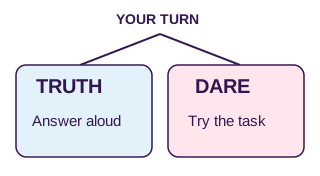
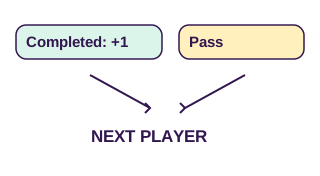
Truth has a similar problem when it becomes a demand for disclosure rather than an invitation to speak. A question can be funny, surprising, or revealing without requiring information a player would rather keep private. The browser tool lets the current player choose a challenge type, then mark a prompt Completed or Pass. The interesting hosting work happens around those choices: selecting a comfortable tone, receiving an answer generously, and keeping the ending recognizable.
The scenes below are Fictional Examples written to examine those decisions. Their paper challenge ideas are illustrative activities, not promises about which generated prompt will appear in your game. They are also not reports that a real group benefited from a measured technique. They show how an imagined host might use a small performance and a modest personal answer without confusing willingness with obligation.
Fictional Example: the opening-night announcement
The curtain in a neighborhood rehearsal room will not open because the rail needs checking. While the caretaker sorts it out, a small volunteer theatre group waits with costumes still in garment bags. They have been rehearsing practical tasks all afternoon, and nobody wants another serious instruction. Carmen suggests a short Truth or Dare round before the final run-through. She says passing will simply move the turn along.
Her spoken demonstration dare is to announce the arrival of a missing teaspoon as if introducing the lead actor at a grand premiere. It has a clear subject, an ordinary voice-sized action, and an ending after two sentences. Carmen performs it first, complete with a rather poor imaginary spotlight. She does not choose the best actor in the room to demonstrate what success must look like. A deliberately modest example makes the invitation easier to understand.
Noah, who normally builds scenery, accepts a different generated dare on his browser turn. He begins enthusiastically, then loses the thread. Two actors start offering louder suggestions, and suddenly his small performance has acquired an audience directing it. Carmen interrupts the additions rather than Noah. She asks whether he wants to finish with the sentence he already has. He does, and she marks the challenge Completed before anyone can demand an improved encore.
The change seems tiny, but it restores the original task. Noah accepted the displayed challenge, not an expanding improvisation devised by the spectators. A completed action should not require a player to keep entertaining the room until laughter reaches a particular volume. The group can enjoy an uneven performance as fully as a polished one. The app's completion point records the decision to complete the challenge; it is not an acting grade.
Then Maren chooses Truth. Her prompt invites a harmless personal answer, but she realizes she does not want to answer it today. She presses Pass without explaining. One friend begins asking whether the question was really too difficult. Carmen starts reading the next player's screen instead. She does not announce a special lesson about respecting Maren, which might make the refusal more conspicuous. The ordinary continuation does the work.
The rehearsal-room story turns when the quietest volunteer later chooses Dare and invents a wonderfully dry delivery. He has seen that an attempt can end before it becomes a spectacle and that declining has no public consequences. That does not prove he would always prefer to perform, or that everybody needed the same reassurance. It simply means this particular invitation now looks manageable to him. The group receives his line and moves on.
When the curtain is ready, Carmen closes the game after the current turn. Nobody has to settle a competition for bravery. Their score contains a few completion points, and their shared memory contains the teaspoon announcement. They return to rehearsal with a useful distinction freshly demonstrated: accepting a small performance is not consent to an unlimited audience response. The boundary made the joke possible rather than preventing it.
Where the finish line belongs
A challenge needs an observable finish that does not depend on the audience's mood. Say three sentences, create one imaginary advertisement, describe an object under a fictional constraint, or make a brief sound in place. Avoid an instruction such as make everybody laugh. A person cannot control everybody's reaction, and tying completion to that reaction encourages the group to keep the turn alive after the player has done the task.
If a displayed dare is broader than the room wants, the player can pass. You can also agree on a harmless spoken adaptation before anybody begins, provided everyone understands you are adapting the activity rather than describing a new interface feature. Keep the central creative action, not the pressure. A seated description can preserve the joke of a dramatic scene without adding movement, contact, belongings, or an unwilling participant.
The audience has a role too. Listen long enough for a beginning to become a sentence. Do not coach every pause, film a performance by default, or call for a repeat because the first delivery was quiet. Ask before taking a photograph or recording anything, and accept a no without negotiation. A challenge designed for a few people in a room does not automatically belong in a group chat afterward.
Fictional Example: the truthful answer that stayed small
On a rainy afternoon in a holiday cottage, cousins who rarely see one another are waiting for a pie to finish cooking. Their last reunion involved a loud question game that left one person feeling interrogated. This time Asha proposes Truth or Dare with a different expectation: ordinary answers count, and nobody will ask a follow-up unless the speaker invites one. They use the browser to keep the current player and the finish of each turn clear.
The first truth answer is almost comically brief. Asked about a harmless mistake, Ellis says he once spent several minutes looking for glasses he was wearing. His cousin Mina knows a much larger story involving a forgotten suitcase and starts to supply it. Ellis smiles but says the glasses are the story he chose. Mina stops and lets him describe the moment he finally caught his reflection in a dark window.
The funny detail is not the size of the mistake. It is his earnest method: he retraced his route and checked a room he could only see clearly because the glasses were already on his face. The group asks whether he wants to add anything, and he says no. They mark Completed. The answer has been received without requiring escalation into the most embarrassing event anyone can remember about him.
Asha then chooses a spoken dare outside the browser as a demonstration of adaptation. She proposes narrating the cottage's kettle as a detective noticing suspicious behavior. Because the kettle is being used to make tea, they agree the task is entirely verbal and nobody will touch it or interfere with cooking. The object provides a premise, not a prop somebody must manipulate. Asha gives her two lines from her chair.
Mina starts laughing before the conclusion because she imagines the kettle concealing a history of stolen biscuits. Asha pauses and invites her to save that addition for another fictional scene. Mina discovers that she wants to contribute an idea more than she wants to perform. On her next browser turn, she chooses Truth instead of Dare and answers a question about a small preference. Her earlier enthusiasm did not commit her to becoming the afternoon's entertainer.
The unexpected difficulty comes when the pie timer rings during Ellis's turn. Somebody jokingly says that a real dare would be finishing before the oven is opened. Asha stops the game. Food and ordinary attention take priority, and an interruption does not need to become a new challenge. They return after serving the pie, decide not to restart the unfinished task, and let Ellis choose afresh if he wants another turn.
The afternoon ends with several tiny scenes and no dramatic revelations. Ellis feels no need to explain why the suitcase story was off limits. Mina has contributed through both listening and imagination. The activity has made room for different kinds of willingness without pretending they form a ladder. A useful truth can be modest, and a satisfying dare can last less time than it takes a pie to cool.
Why a smaller answer can carry more detail
When a group expects a confession, players often spend their energy deciding what they can safely reveal. A small prompt leaves more room for description. A person can explain the shape of a harmless misunderstanding, the sentence they misheard, or the elaborate reasoning behind a trivial error. Those details may be more entertaining than a larger event told reluctantly and without context.
Do not treat the word truth as a license to demand proof. A personal answer belongs to the speaker. The other players can receive it as part of the activity without requesting messages, identifying names, or evidence from someone absent. If the group wants a game about detecting an invented statement, Two Truths and a Lie provides a different structure. Truth or Dare does not require a cross-examination after each answer.
Likewise, a refusal does not reveal the hidden answer. Avoid jokes suggesting that passing confirms the most dramatic possibility. That makes Pass function like an accusation rather than an exit. The easiest response is procedural: move to the next player. Save conversation about the rules for a general check between rounds, rather than asking one person to explain a boundary while everyone waits for their next choice.
The difference between suspense and pressure
Suspense can be enjoyable when a player wants to see a prompt and knows they can decline it. Pressure appears when the room makes declining socially expensive. The interface's pass-token display must not be treated as permission to compel a challenge after a counter reaches zero. In this tool, passing remains available. Explain that clearly before a playful counter becomes an invented obligation.
Watch for a changing audience. A dare comfortable among three friends may feel different when a visitor enters, someone starts a video call, or a phone camera appears. The original player can stop. You do not need to decide whether the new situation is objectively more embarrassing. The relevant fact is that the conditions changed. Restarting a turn is less costly than preserving a completion rule nobody agreed to under the new circumstances.
Hosts sometimes worry that easy exits will drain the energy from the activity. A more useful concern is whether the invitations have enough variety. If every dare asks for a public performance, the same confident people will dominate. A harmless description, tiny invention, or imaginary announcement can offer a different scale of participation. If nobody wants any of the available prompts, choose a conversation or ranking game instead of interpreting the room as a challenge to overcome.
A practical rhythm for a friendly round
Before starting, describe the tone in a concrete example. Saying keep it safe is less informative than explaining that the session uses spoken, seated or wholly imagined actions and does not involve outsiders, personal accounts, dangerous movement, or other people's possessions. Make the agreement short enough that a host can apply it in the moment. If a proposed action conflicts with it, replace the action rather than adding a warning to be careful.
During play, let the current player make the type choice. Read the revealed prompt fully before treating acceptance as settled. Use Completed when the agreed action or answer is finished; use Pass when the player declines or stops. Follow the browser's rotation instead of letting the room's loudest participant choose who must go next. An orderly turn can create space for spontaneity without letting spontaneity become control over someone else.
Between turns, check the room rather than delivering a lecture. Are people listening to the player, or inventing additions over them? Is the same person repeatedly receiving prompts they dislike? Would the group prefer fewer performances? A simple change of format can be enough. The goal is not to prove that this game suits every gathering. It is to recognize when its particular invitation fits the people present.
When you finish, end with the current choice or a clearly announced final turn. Do not ask for one last outrageous task to justify the session's name. The strongest memory may already be the quietest line, the neatly completed attempt, or the fact that somebody could pass and remain part of the fun. A good challenge leaves the player in possession of their own ending, and leaves the group willing to offer another invitation later.
Review the action before admiring the joke
A comic description can disguise a practical demand. Before approving an adaptation, identify who acts, what changes, who else is involved and how the action stops. A pretend announcement changes only the conversation. Sending an actual message recruits an outsider; moving another person's belongings changes their environment. Those are different actions even when the joke describes both with the same playful language.
If a challenge fails that simple review, keep its fictional premise and replace its real consequence. An imaginary invitation to a mayor can be read to willing listeners without contacting anybody. A description of an absurd dance can remain a description. This is more useful than adding a general instruction to be careful, because the player can understand the accepted action before deciding whether to attempt it.