A surprising statement gives a quiz a clean opening: choose True or False. The choice can be made in a second, but the interesting work may begin when someone asks why they believed it. Did it resemble something they remembered? Did an impressive number make it sound researched? Did the claim seem too ordinary to have been invented? A factual game can make those reactions visible without treating every mistaken guess as a failure of character. Curiosity survives correction more easily when the explanation becomes part of the entertainment.
Weird Fact or Fiction gives each statement a stored answer, an explanation and a source link. That makes it different from a room voting on the most plausible story. The majority can be mistaken, and the person who guesses correctly may not know why. A useful host keeps those distinctions intact. Points record the choices made in the game. They do not certify that every winner conducted research or that every incorrect player ignored evidence. The source gives the group somewhere to go after intuition has had its turn.
A claim is smaller than its subject
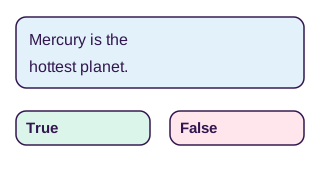
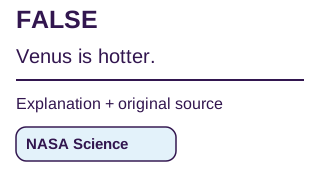
“Something about Mercury” is a topic, not a proposition you can check. “Mercury is the hottest planet” is a specific comparison. NASA identifies Venus as the hottest planet in our solar system, despite Mercury being nearer the Sun. That directly supports marking the game's statement False. The lesson is not that a familiar institution should replace thinking; it is that the cited page addresses the actual comparison. Read the relevant explanation rather than assuming a link about the same planet must support every statement attached to it. NASA's Mercury facts states the distinction explicitly.
The explanation can also correct the reasoning behind a plausible mistake. Distance from the Sun is not the whole comparison: NASA's Venus page describes the role of its thick atmosphere in trapping heat. For this example, the relationship between the two pages matters more than memorizing a temperature. You can explain why the answer differs from the nearest-planet guess without inventing an extra scientific mechanism. Keep the explanation within what the source supports. A quiz host need not become an atmospheric scientist to read a precise source carefully. NASA's Venus facts supplies that context.
Fictional Example: the quiz that paused at one answer
The gathering in this story is fictional; the planetary comparison above is sourced. At a small apartment dinner, Amira starts a short fact session while the food cools. Her brother Cal chooses True for the Mercury statement and explains afterward that the closest planet ought to be hottest. Another guest, Wren, had chosen False but admits that the choice was a guess. Amira reads the result and prepares to move on. Cal asks whether the answer could be using a night temperature rather than a daytime one. The question gives the group a reason to open the source.
Instead of declaring that Cal is trying to evade a lost point, Amira separates the tasks. The recorded answer stays as the game recorded it. The group can still inspect what “hottest” means in the source explanation. Wren reads the NASA comparison aloud in her own words. Another guest opens the linked Venus page to understand why distance alone does not settle the result. They do not race to find a search snippet contradicting one another. They begin with the source actually supplied for the card and follow the explanation it provides.
The turn in the evening comes when Wren says she cannot honestly claim superior knowledge for her correct click. Cal's mistaken explanation supplied the question that made the card worth discussing. Nobody changes their points to reward humility or inquiry; that would be a different scoring system. They simply stop treating the existing score as the complete account of what happened. The table can enjoy Wren's lucky point, Cal's useful question and the source's explanation without forcing them into one hierarchy. Their conversation becomes more interesting than an argument over who was smart.
Amira notices a practical problem: reading every source in full would interrupt dinner indefinitely. She offers a rhythm for the remaining cards. Each player answers first; after the reveal, someone can nominate a claim for a longer check at the end. They finish a modest number of turns and choose one further explanation to inspect. This is a hosting agreement around the tool, not an automatic bookmark queue it creates. The browser still handles the actual answer, point and streak; the people decide when they want to leave the sequence for source reading.
At the end, Cal repeats the corrected comparison without being prompted to apologize for his original guess. Wren remembers the atmosphere explanation because it resolved a question she heard a friend ask. Amira ends the session rather than requiring everyone to complete an arbitrary card quota. The small success is not that the game made the guests expert fact-checkers. It is that one surprising result became a shared inquiry, and the group found a way to check it without turning the dinner into a contest of authority or an endless series of browser tabs.
If you use this pattern, distinguish answer time from explanation time. Do not let a knowledgeable participant announce the correct result before the current player has chosen. After the reveal, invite a reason or a source question rather than demanding a defense of an incorrect answer. Keep research voluntary and bounded. A person may enjoy answering several cards but not reading a technical page aloud. Offer that reading role to someone who wants it, then summarize the specific finding before returning to the game or finishing the activity.
What a source link promises
A source link is an invitation to inspect support, not a decorative badge. Check whether the page says what the card says, whether a qualifier has been removed and whether the comparison uses the same units or timeframe. A statement can become misleading by losing a single word such as “some,” “usually” or “observed.” This is a method for reading claims, not an assertion that a particular unquoted card has those problems. The appropriate response to uncertainty is to narrow the wording or set the card aside, not to invent confidence because a game needs a binary answer.
Distinguish a source's direct observation from a theory, proposal or speculation it discusses. A page may mention several explanations while endorsing none as settled. Merely finding a sentence containing the desired words does not establish the card's conclusion. Read the surrounding paragraph and identify what kind of statement is being made. If the source says evidence is insufficient, preserve that uncertainty in any explanation you write for a separate paper quiz. A yes-or-no game should choose claims suited to a definite answer rather than flatten every interesting unresolved question into certainty.
Dates deserve attention when the statement concerns a record, an observed count or a classification that might change. The presence of a verification date helps describe when a card was checked; it does not freeze the world afterward. You do not need to interrupt a casual session by auditing the entire bank. If one claim appears outdated, stop using that claim as a definitive teaching example until it can be checked. Do not quietly replace its wording in your retelling while presenting the old answer as though it supported the revised statement all along.
Illustrative Scenario: a homemade claim that stayed out
The second case is a fictional editing session, not a claim about an actual scientific finding. A student media club wants to make a paper quiz for its newsletter. One draft reads, “Every city garden contains a plant that opens its flowers only at midnight.” The sentence was invented for this scenario to show an overbroad claim; it is not a fact supplied by Quirky Query Hub. Club member Oren likes its dramatic sound and wants to label it True because an article he remembers described a night-flowering plant. His editor, Sal, asks what would have to be verified.
They underline three different parts: every city garden, the existence of a suitable plant, and the exact midnight restriction. Evidence for a single plant species would not establish that it occurs in every garden. Evidence that it opens at night would not establish a clock-specific boundary. The attractive sentence has combined several propositions into one apparently simple choice. Oren starts looking for a quotation that can rescue it, but Sal suggests a different task: write the most precise question their actual evidence could support rather than search only for words resembling the draft.
Their source notes do not support a usable replacement yet. Instead of filling the gap with a new invented species name or a convenient expert quotation, they leave a blank in the paper quiz. For the club meeting, they use the live fact game to experience how a statement, answer, explanation and source belong together. The homemade garden claim is discussed openly as an editing failure, not entered into the browser bank or presented to newsletter readers as a genuine natural-history fact. The fictional example demonstrates withholding a claim, which can be the most responsible outcome of checking it.
Oren is initially disappointed because the blank seems less entertaining than the sentence he brought. Sal proposes making the editing process itself part of the newsletter: explain how the words “every” and “only” changed the burden of proof, without circulating the draft as a true fact. The club agrees. Their useful result is an article about asking a better question, not a rescued quiz point. The case differs from the dinner story because there is no established answer to reveal; the work is deciding whether an unsupported question deserves to be asked as factual trivia at all.
For your own paper additions, make that distinction explicit. The live game's existing cards and your homemade drafts are different collections. Do not imply that a spoken claim becomes a verified Quirky Query Hub card because you discuss it beside the browser. Keep drafts in a separate note until a relevant reliable source supports the exact statement. If you cannot check it, choose another question. A shorter quiz containing clear claims is more useful than a full sheet whose most memorable item becomes something readers must later unlearn.
A correct answer can still deserve a second look
A player may choose correctly through a mistaken argument. Someone can reject a claim for a reason that would also reject several true claims. Invite the reasoning after the result when the participant wants to share it, then compare that reasoning with the explanation. Keep the tone exploratory: which part of the source supports the answer? A fortunate click need not be exposed as a fraud. It can become the beginning of understanding. That is a more welcoming invitation than treating the explanation as a prize available only to people who were already right.
An incorrect answer can arise from careful reading of an ambiguous sentence. If a participant identifies a legitimate missing qualifier, do not respond that the answer key makes discussion unnecessary. The key records the tool's intended decision. The source and wording remain inspectable. For a casual gathering, leave the recorded result alone and decide whether to skip further use of the disputed claim until reviewed. This avoids pretending an unoffered live editing function exists while still taking the reader's objection seriously. The group's intellectual conversation can be more nuanced than the two answer buttons.
Make explanations proportional. A single clear distinction may resolve a card; it does not need a complete lecture on the subject. If nobody wants to read further, acknowledge what remains unknown rather than filling the silence with an improvised scientific story. A host can say that the linked page supports the answer and invite interested players to return later. That is more honest than using unfamiliar terminology to make a thin explanation sound complete. The card's source is available precisely so the host need not become the sole authority in the room.
Build a habit the session can actually sustain
Before starting, ask whether the group wants a brisk quiz, a discussion of surprising explanations, or a mixture. The same card sequence can support different evenings, but not every preference fits the same pace. A family might play a handful of turns and investigate one source together. A pair might stop at the first disagreement and spend the rest of the break reading. Those are meaningful uses of the tool even if the number of completed cards is small. The activity's value is not proportional to how many statements pass across the screen.
Keep a distinction between saving the game record and saving your research notes. Browser history can preserve the game's interactions where supported, while an exported backup preserves local records. It does not automatically produce an annotated bibliography explaining every source question the people discussed aloud. If you want to revisit a claim, note its exact wording and source URL separately. Avoid copying only a memorable fragment; qualifiers are often the part most likely to disappear in a retelling. A useful note should let another reader identify the same proposition you checked.
The most satisfying ending is a precise sentence you understand better than when the game began. Perhaps a confident guess changed, or a lucky answer acquired a reason. Perhaps the group discovered that a homemade claim was not ready for a quiz. None of those outcomes requires a dramatic lesson about trusting nothing. The smaller habit is enough: let curiosity produce a question, let the question point toward evidence, and let the evidence determine how confidently you speak. A strange fact remains entertaining when checking it becomes part of its story.