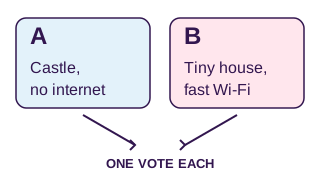
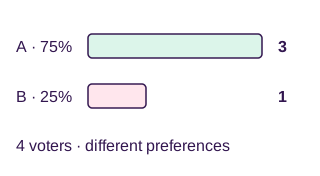
A two-choice question looks like a small machine. Put two possibilities in front of a room, collect a decision, and display a tally. Yet the reason to play Weird Would You Rather is rarely the number at the end. It is the moment somebody explains a perfectly sensible reason for choosing the option everybody else dismissed. The strange premise gives people enough distance from ordinary decisions to say what they value without delivering a speech about their personality.
This feature explores that moment through two fictional gatherings. Both are Illustrative Scenarios, not reports from customers or descriptions of measured outcomes. Their invented dilemmas are discussion material, not a claim that those exact cards appear in the live question bank. The browser activity supplies its own pairs, records each player's A or B choice, and shows the room's actual tally. A host can use the same discussion methods with whatever pair appears.
A choice becomes interesting when both losses matter
The most useful dilemma is not necessarily the loudest one. An obviously wonderful option beside an obviously miserable alternative gives people little to explain. A better pair offers two different advantages with meaningful inconveniences. One person might accept unpredictability for freedom, while another prefers a reliable limitation. Neither needs to be mistaken for the conversation to have somewhere to go.
Listen for the assumption behind a vote. Someone choosing an underwater library might imagine quiet reading; another hears the word underwater and imagines constant maintenance. The disagreement begins before either person weighs the benefits. Clarifying that hidden picture often produces a more interesting exchange than trying to persuade the other side immediately. Ask what an option looks like on an ordinary Tuesday, rather than demanding a defense of a whole worldview.
Keep clarification fair. If the group gives one option unlimited exceptions but interprets the other literally, it can argue its preferred answer into an easy victory. Agree on one small assumption that makes the pair playable, then use it for both choices. A fictional rule does not require a legal document. It requires enough common ground that the next explanation answers the same question as the first.
Illustrative Scenario: the bus-stop committee
Four neighbors are waiting in a community center for a delayed shuttle to a neighborhood film screening. They have met before, but mainly while carrying groceries or collecting parcels. Leila has brought her phone, and an empty twenty minutes feels long enough for a small activity but too short for introductions around the table. She suggests three choice rounds, with no requirement to tell a personal story.
Their paper warm-up asks whether they would rather have a bus that always arrives early but waits for nobody, or one that arrives late but never leaves a passenger behind. Leila says this invented question is separate from the site's generated cards. She asks everyone to choose privately before discussing it. Omar picks the early bus immediately. Ruth picks the late bus. Ben hesitates, then chooses the early one because he dislikes waiting in the rain.
The first explanations seem predictable. Omar likes schedules; Ruth likes consideration. Then Ruth says she has imagined a bus returning for a passenger who cannot walk quickly. Omar has pictured a bus waiting while somebody finishes a shopping trip. They have supplied different missing facts. Instead of declaring a winner, Leila asks them to agree that passengers have reached the stop before the scheduled departure. Suddenly Omar is less certain about his original answer.
Ben adds a complication without changing either option: perhaps the late bus always arrives ten minutes late, so everyone can plan around it. Ruth laughs because he has turned lateness into a timetable. Leila asks whether the group wants that interpretation to count. They decide it does, but only if they say so before another vote. The revised premise is now clear enough that a change of mind means something visible.
They open the browser game for the next round, enter the four names, and read the generated A/B pair in full. Each person chooses on their own turn and passes the device. Leila waits for the group result before inviting explanations. She does not turn the fictional bus vote into a browser statistic or pretend the earlier paper answers were submitted. The distinction keeps the displayed tally honest and the warm-up useful.
The unexpected moment comes when Omar chooses the less convenient generated option for a reason that has nothing to do with punctuality. The group had begun to label him the schedule person after a single answer. His explanation makes that label look too small. Ruth starts to say that he has contradicted himself, then asks what changed in this pair. He explains that the inconvenience is temporary, while the benefit would be available every day.
The shuttle arrives during the third discussion. Nobody needs the next question, and Leila does not ask people to finish a sequence to make the activity count. They leave with a new question to continue on the bus: which inconveniences are annoying once and which become exhausting through repetition? That question emerged from listening to their actual reasons. It was not a moral attached to the opening premise in advance.
What a host can borrow from that scene
The useful intervention was not an extra rule about winning. It was the request to describe the same circumstances. A host can notice when answers depend on incompatible pictures and offer a single clarification. If people disagree about whether that clarification improves the question, let the original vote stand and move on. Repairing every premise can become a longer activity than the game itself.
Private initial choices also mattered. Leila did not ask the most confident speaker to establish the reasonable answer first. In the browser, follow the voter prompts and resist narrating another player's choice before they make it. The tally can then introduce a discussion that contains genuine differences, rather than confirming the opinion that arrived in the room fastest.
Changing a vote during the conversation is not a failure of the first answer. Distinguish the recorded result from later reflection. The browser tally describes the choices entered in that round. A host can say that the conversation changed somebody's mind without editing history to make the room look more consistent. If the group wants a rematch, treat it as a fresh comparison and state the clarified premise first.
Illustrative Scenario: two siblings design an imaginary shop
Nadia and her younger brother Felix meet on a video call after a week when both have spent too much time making practical decisions. Neither wants to explain their entire week. They agree to use two-choice questions as the starting material for inventing a tiny imaginary business. This is a spoken variation around the activity, not a business-building feature of the browser tool.
Their invented warm-up asks whether their shop should sell umbrellas that predict compliments or notebooks that remember forgotten jokes. Nadia chooses the notebooks because she imagines keeping a good line until the right occasion. Felix chooses the umbrellas because he imagines customers gathering outside to hear the forecast. One is designing a useful object; the other is designing a social place. Their disagreement gives the shop a direction before either proposes a name.
Nadia notices herself trying to prove that umbrellas would make customers vain. Felix points out that the premise says compliments, not praise from strangers. He imagines the umbrella reminding somebody that they have been a patient friend. Instead of adding another objection, Nadia asks what happens when the umbrella has nothing to say. Felix pauses. The answer could make the object cruel, so they agree it forecasts only silly compliments from fictional pigeons.
That adjustment reveals a boundary in the story rather than a judgment about either sibling. They want the imagined shop to be playful, not an instrument that evaluates its customers. They do not need to claim the original option was unsafe in every interpretation. They simply identify the version they would enjoy developing together. Nadia now likes the umbrella idea more, though she still prefers to own the notebook.
They return to the actual game, read a generated pair, and each gives an answer before returning to their shared fiction. Since they are discussing over a call, they make clear who is entering each choice on the shared device. The person holding the browser does not invent an absent vote. Once the two real responses have been recorded, they use the displayed split as a prompt for their shop's next fictional problem.
The session ends with a shop selling both objects on alternate days, which deliberately escapes the original forced choice in their story. They recognize that the game round still had two options. Their creative continuation is something they made afterward. The distinction lets the choice provide a useful constraint without requiring every subsequent conversation to remain inside the interface's exact structure.
From defending an option to noticing a tradeoff
A person may choose an option because it is more enjoyable to discuss, not because they would want it in real life. Ask whether they are answering as themselves, as a character, or as a writer looking for a better scene. Any of those approaches can work, but a group comparing them as if they were the same can misunderstand an amusing answer as a serious confession.
This matters especially when the subject resembles a real preference. An imaginary travel choice might involve independence, comfort, company, or novelty. It does not establish whether somebody is a good traveling companion. A playful answer gives a small piece of context under stated fictional conditions. Leave room for the person to say that their ordinary choice would be different when money, health, or responsibilities enter the picture.
Try following an explanation with a concrete scale change. Would the inconvenience be acceptable for one afternoon, one month, or every day? Which part becomes tiring first? This develops the original tradeoff instead of replacing it with an unrelated question. Use one follow-up, then listen. Three clever follow-ups delivered without space for a response can feel like an examination disguised as curiosity.
Another useful move is to ask what would make the other option worth choosing. A player who strongly prefers A can name one circumstance favoring B without abandoning their answer. This makes room for flexible thinking while keeping the activity light. The aim is not to make every person arrive at a balanced conclusion. Some options remain delightfully unacceptable after a perfectly fair explanation.
Choosing the right amount of conversation
With a group meeting for the first time, use questions whose reasons can remain ordinary. Let a preference be enough. If somebody says they prefer the quieter option, do not demand a story about why noise matters to them. An accessible opening offers several levels of contribution: choosing, giving one reason, asking a question, or listening until the next round. None has to become a permanent role.
In a familiar group, the risk can be the opposite. Friends may explain somebody's answer for them before they speak. Invite the actual voter to describe this particular choice. The person who usually plans everything may choose a chaotic option because the premise makes chaos manageable. Hearing that explanation can be more enjoyable than another joke about the role the group already assigned them.
For mixed ages, clarify unfamiliar words before voting. Do not simplify the ideas so far that younger participants can only agree with an adult's explanation. They may have a practical objection nobody else noticed: where an enormous animal sleeps, who carries a magical object, or whether a supposedly helpful invention gets in the way at school. Specific questions make those contributions visible without turning them into a test.
If the room wants quick laughs, shorten the discussion rather than rushing each person's vote. Collect all responses, invite one surprising reason from either side, then move on. If the conversation becomes absorbing, allow the game to become background material for a while. A successful gathering does not require a fixed quantity of generated cards. The useful unit is a choice people had time to understand.
Let the result remain small enough to enjoy
The final tally belongs to the room and the round. It is not an opinion poll about the world, and it cannot explain why each person voted. Two matching choices may come from opposite reasons. Two opposing choices may rest on the same desire expressed through different pictures. Asking about those pictures is what gives the small machine its larger range.
When you open the next round, carry forward curiosity rather than a verdict about the players. You have learned how someone imagined one strange possibility today. That is enough material for another question, a running joke, or a story continued on the way home. The activity can end while those possibilities remain open, with no need to turn a playful difference into a settled account of who anyone is.
When two people hear different costs
A useful repair is to separate the benefit from its price in one sentence. Ask each side which inconvenience they have accepted, not just which reward they want. A participant may discover that they overlooked a recurring cost, while another reveals that the cost is the very thing they find amusing. Give them time to reconsider before another player argues the choice for them.
If an argument starts circling around a definition, write the two interpretations aloud as alternative versions of the question. Choose one for this conversation and keep the other for a later spoken variation. This preserves both ideas without pretending the current browser card has silently changed. You can then compare how one altered condition changes the reasoning, rather than spend the gathering trying to prove that only one reading was ever possible.