The first impossible thing in a story usually gets attention easily. Every elevator might deliver a different season, or every receipt might contain tomorrow's weather. The harder task arrives in the next sentence. Once the reader accepts the new rule, what does somebody do because of it? Adding another unrelated impossibility can create noise without creating a scene. A useful continuation stays long enough with the first change for it to affect an ordinary intention. The character still wants lunch, a safe ride home, or a place to put a wet coat.
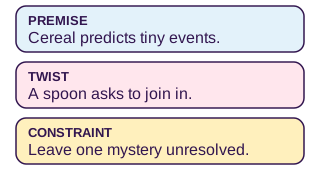
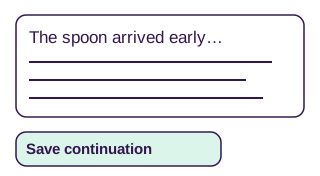
What-If Twist Lab offers a scenario, twist and constraint as a shared starting point. Contributors write continuations and save them to local history. Writers can take turns sharing the page, but it does not supply a correct ending or an automatic quality score. That leaves a valuable responsibility with the participants: deciding which details to preserve and which consequences to explore. The combination is a seed, not a finished story. A lively session gives each writer somewhere to enter without requiring every new contribution to erase what came before.
An ordinary intention gives the strange rule resistance
Imagine a world in which shoes can vote on their destination. That rule becomes more interesting when a delivery rider needs to reach a particular address before a fictional birthday cake loses its shape. Now the shoes' preference matters. If everybody merely admires the novelty of voting footwear, the premise remains an announcement. When a character has an ordinary goal, the reader can notice what the new rule makes easier, harder, or unexpectedly negotiable. The story has friction because two understandable things cannot both happen in the simplest way.
The goal need not be dramatic. A character may want to return a borrowed bowl without letting its owner see a chip, find a quiet place to read, or get a paper invitation across a crowded room. Small tasks are useful because contributors can understand them quickly. They also discourage a group from escalating every turn into catastrophe. An imagined world can be full of possibility while its current scene remains modest. The question is what this rule does to this task, here, before the character changes their mind or tries another approach.
Fictional Example: the parcel that wanted a destination
The following invented story develops an offline prompt. Its exact premise and constraint are not guaranteed live bank combinations. Three cousins, Imani, Sol and Bea, are staying indoors during a long afternoon. They agree to write a short shared story in which parcels may choose the last street of their journey. The twist is that a parcel contains something intended for a surprise. Their paper constraint is that the scene must remain inside one building. Each cousin will add a paragraph and preserve at least one detail from the previous contribution.
Imani begins with a parcel on the caretaker's desk in a fictional apartment building. Its label names a resident upstairs, but the parcel keeps folding one corner toward the lobby door. The caretaker wants to deliver it quietly before the resident returns. The first paragraph does not explain the entire world. It shows a practical problem: a person has an address, an object has a preference, and both are confined to the same place. Sol can now continue with an action instead of inventing a new premise from nothing.
Sol decides that the caretaker asks the parcel where it wants to go. He is tempted to make it speak in a grand voice, but the group has only established movement through a folded corner. He keeps that physical signal. The caretaker draws a rough floor plan on an old notice, and the parcel points toward the shared kitchen rather than the named apartment. This is a consequence of the existing ability, not an unrelated new power. It also respects the one-building constraint while giving the story a destination that differs from the label.
Bea reveals that a neighbor in the kitchen has been trying to repair a paper lantern for the resident's surprise welcome. The parcel might contain a missing piece, but she stops short of specifying it. Instead, she has the caretaker listen at the kitchen door, hear a frustrated sigh, and hesitate about opening a surprise package. The cousins now disagree. Imani wants the parcel to contain an apology letter. Sol expects a lantern part. Bea likes the uncertainty and wants to end with the caretaker inviting both neighbors to inspect the label together.
They pause the writing rather than resolving the disagreement by adding a larger magical event. Each cousin names what their preferred ending would explain. The apology would explain secrecy but not the damaged lantern. The spare part would connect the kitchen problem but might make the destination too predictable. The joint inspection would preserve consent around the package but leave its contents unresolved. They choose a fourth possibility: the parcel contains a small card asking its recipient to help finish the lantern. The surprise is an invitation to contribute, not a completed gift delivered to a passive person.
Their final paragraph has the caretaker bring the unopened parcel to the kitchen and knock. Nobody is required to tear it open or guess another person's private message. The parcel relaxes its folded corner when it reaches the worktable. The cousins end on that visible detail rather than adding a paragraph that explains the meaning of community. The story has moved from resistance, through investigation and disagreement, to a practical action that uses the original rule. Its small conclusion feels earned because the earlier details have not been discarded to make room for a surprise ending.
The most useful hosting move was the pause before the final paragraph. A disagreement about direction became a comparison of what each ending would explain. That is a more concrete conversation than asking whose idea is best. In the live Lab, contributors can read the actual three-part combination, write a continuation, save it, and consult the local history before handing over. If a group wants a paper rule about preserving one detail, announce it as an extra writing agreement. Do not describe that agreement as an automatic check that the site enforces.
A twist should disturb a choice
A meaningful twist changes what a character can reasonably decide. Revealing that a guidebook is written by the destination might alter whether a traveler trusts its directions. Revealing that every bench is blue may be decorative unless color matters to the task. A writer can ask what the new information makes the character do differently. The answer does not have to be a large reversal. It may change the order of two actions or make an obvious shortcut less attractive. That small pressure can carry a scene farther than another spectacular image.
The same test helps a group avoid twists that simply cancel earlier work. “It was all a dream” can erase a carefully shared situation unless the dream itself has a consequence the story has prepared. If somebody adds an ending that makes the preceding choices meaningless, ask what remains true from the earlier paragraphs. Sometimes the best revision is to keep the revelation but let the character remember one obligation or object. The writer is not forbidden to surprise the group; they are being invited to make the surprise use the material the group already created.
Constraints are useful in a similar way. A limit on location, available objects, or form can focus invention by removing easy exits. Treat the actual displayed constraint as part of the task before writing. A participant who misses it should have a chance to revise without being mocked for failing to notice a line on screen. Read all three parts aloud when sharing one device. A story that ignores the constraint may still be enjoyable, but it is exploring a different starting problem from the one everybody agreed to develop.
Illustrative Scenario: a solitary writer follows one consequence
This separate fictional example concerns a writer working alone on paper. The premise is that a public clock can give away one unused minute at closing time. The writer initially drafts a citywide contest in which hundreds of people chase the minute. The scale promises excitement, but the first page becomes a list of rules and committees. She has no particular person whose decision she wants to follow. She sets aside that version and begins with a cleaner who needs one more minute to finish a small chalk drawing before the rain starts.
The clock offers the minute, but the cleaner discovers that using it will also delay the person waiting to lock the courtyard. The gift has a local consequence. The writer now has a choice to dramatize instead of a city to administer. Her first ending lets the cleaner save the whole drawing. On rereading, that ending feels too tidy because the waiting person's time has disappeared from consideration. She revises the scene so the cleaner protects one small section, then helps close the courtyard on schedule. The clock's unused minute remains visible, but it does not solve every competing need.
She compares the drafts by asking what changed, not by rating one as universally better. The large contest version might suit a different project. The courtyard version suits the scene she can actually finish that afternoon. She keeps a note about the abandoned city because it contains another possible story, then stops when the cleaner makes the choice. A continuation exercise has helped her discover a scale and an ending. It has not certified that her story has a profound lesson or supplied an objective measure of imagination.
On the live page, a solo contributor can use the drawn scenario, twist and constraint, save a continuation and return to the saved history. The app does not need a second player to make the writing worthwhile. The writer should still distinguish what the tool supplied from what they invented. If they want to explore the courtyard premise exactly, it can remain a separate notebook exercise. The transferable method is to follow one consequence through a character's action, then compare a revision against that intention rather than against an imagined universal standard.
Give the next writer a handle
A collaborative paragraph can end with a usable detail rather than an instruction. A sealed envelope on a worktable, a shoe pointing away from a doorway, or a sentence interrupted by a familiar noise gives the next contributor something to choose from. Ending every turn with “and then something amazing happened” offers little support. Conversely, prescribing exactly what the next character must do can leave the next writer no room. A good handoff opens a decision while preserving the shared situation that makes that decision interesting.
Before adding a paragraph, identify the last confirmed action. Then decide which uncertainty you are addressing. This quick check helps prevent accidental contradictions, especially when a story has grown through several turns. It does not require a formal continuity spreadsheet at a party. One spoken sentence may be enough: the parcel is still closed, the caretaker is outside the kitchen, and the resident has not returned. The next writer can change any of those facts through an action, but they should not silently assume that somebody else already did so.
If two writers remember a detail differently, choose a version together and continue. The saved text can settle what was actually entered, but a group may voluntarily revise its fiction. Avoid turning a minor inconsistency into a contest over whose memory is official. The purpose of a record is to support the story, not to supply evidence against its contributors. If a revision matters, say what changed so the next person is not working from the discarded version. Clear handoffs are more useful than elaborate rules that nobody can remember during the scene.
Let different kinds of contribution count
Some writers naturally add action, others setting, others dialogue. A group does not need every paragraph to perform all three tasks. It does need movement across the scene as a whole. If several turns have only described the room, invite the next contributor to choose one action a character takes because of something already described. If the action is racing ahead without a clear setting, ask where the next decision happens. These invitations respond to an actual gap rather than assigning someone a permanent role as the imaginative person or the practical editor.
For participants who prefer speaking, a willing reader can enter the words they dictate. Confirm the wording before saving, especially if an informal paraphrase changes the character's intention. The person handling the device should not become the unannounced coauthor of every turn. Younger players can contribute a short consequence rather than a polished paragraph. A sentence that makes the parcel point toward a different room may do more narrative work than a long descriptive passage. Keep the contribution's value attached to what it adds, not to its length or performance.
Stop at a changed situation
A short session does not need to explain the entire imagined world. It needs to leave the current situation somewhere different from where it began. The caretaker has moved from forcing a parcel toward an address to asking a neighbor about an invitation. The cleaner has chosen which detail to preserve before the gate closes. Those changes can be complete enough for an afternoon's activity even though many questions remain. An ending that leaves room for curiosity is different from stopping before anybody has made a choice.
Read the final paragraph once without adding more suggestions immediately. Let the group hear what it made. People may want to name a detail they enjoyed, save their own writing, or begin a new combination. None of those choices requires a creativity score. The Lab's useful promise is a shared starting point and a place to keep continuations locally. What participants build from it depends on attention to the premise, willingness to follow a consequence, and enough trust to let somebody else carry a familiar detail in an unexpected direction.