
Quirky Query Hub playbook · 2 minute read
A round to try
Use three statements about favorite rainy-day activities.
Family players may choose preferences instead of personal history. Keep the lie harmless and reveal it promptly.
Put it into practice
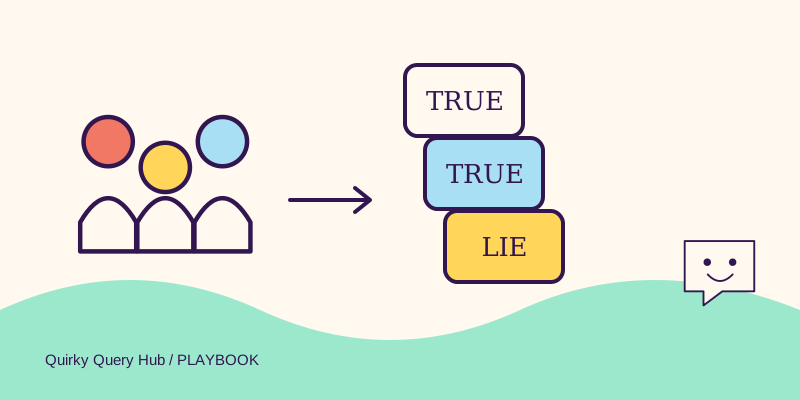
Preference statements let children play without sharing private experiences. Choose two real likes and one invented like, then explain the invention after the guesses. Nobody needs to prove a true statement with a photograph, message, or another person’s confirmation.
Use an invented character as a warm-up
Start with a fictional family member called Captain Crumb. Offer three sample statements: Captain Crumb collects tiny notebooks, once built a cardboard telescope, and owns a castle made of invisible cheese. The reader’s private answer key declares the notebooks and telescope true and the cheese castle false for this round. The reveal follows that authored key; an impossible-sounding claim is not automatically false in a fictional world. Children can practice selecting a statement and hearing the reveal without feeling that they have failed a personal knowledge test. Explain that a believable real round will use an ordinary invented detail rather than an obviously impossible one.
For the family round itself, suggest memories about crafts, meals, games, or small achievements. Let younger players ask an adult to write their ideas while keeping ownership of the final choice. Nobody should be expected to discuss school difficulties, money, health, or a family disagreement. If a participant prefers not to share personal facts, they can play another fictional character and announce that variation before starting. Adults should not supply so many details that children never get a chance to guess. A useful turn ends with one optional follow-up, such as what was the hardest part of making that. Award a point for finding the lie, then rotate the reader. Keep the score light enough that the most enjoyable true story can matter as much as a correct answer.
A few good questions
Can children use preferences instead of experiences?
Yes. Two real likes and one invented like preserve the structure without requiring a personal history or proof.