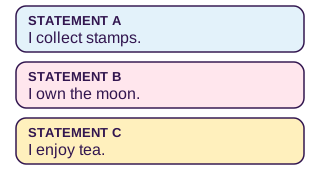
Two Truths and a Lie creates a small puzzle out of self-description. The author controls which three sentences enter the room, while the listeners must decide which one was invented. The obvious temptation is to make the truths spectacular and the lie even more spectacular. That can work briefly, but an interesting set often depends on something quieter: the contrast between what an audience expects and what an ordinary person has actually chosen to do.
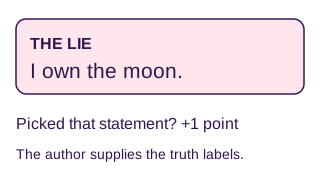
The author is not offering their entire life for inspection. They are selecting two true statements and one false statement for a defined activity. Listeners can enjoy the uncertainty without demanding private evidence or using a mistaken guess to announce that someone looks dishonest. The browser shuffles the supplied statements, collects guesses and reveals the stored lie. It does not detect deception from a voice, face or writing style, and neither should a host claim that the game has established such an ability.
These two Example Stories are fictional. Their character experiences were invented for this feature and must not be presented as real user feedback. The custom statement sets illustrate a real authoring function of the tool. If you borrow the story's writing method, supply truthful material of your own or clearly declare a separate fictional-character variation. The activity loses its premise if invented events are quietly presented as the author's actual biography.
Example Story: the postcard in the drawer
At the first meeting of a community walking group, four people stay after the route briefing to share a drink. Their organizer, Dorian, suggests a short round of Two Truths and a Lie. He does not ask for the strangest event in anybody's life. He demonstrates with three small statements and explains that no one will need to identify another person or produce a photograph to support an answer.
Mei chooses a set about objects she has kept: a postcard she never sent, a ticket for a concert she never attended, and a teaspoon she once won in a poetry competition. In this fictional account, the postcard and teaspoon are true; the unused concert ticket is the invented statement. Each sentence has roughly the same amount of detail. The lie does not arrive with an elaborate explanation while the truths remain thin, and the truths do not announce themselves through obvious emotional emphasis.
Dorian helps her enter the two truths in the appropriate fields and the invented statement in the lie field, keeping the author screen out of view. After Shuffle and hide the lie, the visible order changes. He reminds the group to choose the sentence by its content rather than remembering where a particular field appeared during setup. Then he passes the device so each eligible player can make a guess before the reveal.
Two people suspect the teaspoon because they assume poetry prizes would be books or certificates. Another suspects the postcard because Mei seems like someone who would finish a message once she began it. Dorian notices that the explanations are guesses about plausible situations, not evidence about her honesty. He keeps his own reaction neutral while the final participant chooses, so an early nod does not tell the next player what to select.
The reveal identifies the concert ticket as invented. Mei explains that she has never had the experience of buying that ticket; she chose it because it sounded ordinary enough to compete with the other statements. The teaspoon came from a small library event where the prizes were intentionally miscellaneous. The postcard stayed in a drawer because she liked the picture and decided she wanted to keep it. Neither truth requires a dramatic secret to become surprising.
The turn changes when one listener asks who the postcard was meant for. Mei says she would rather keep that part private. Dorian moves to a question about the picture, which she has already offered as the relevant detail. She describes an unusually plain photograph of a harbor wall. The conversation develops through the object she chose to discuss rather than through the relationship the group would like to investigate.
They finish after each willing author has supplied a set. The displayed points record which guesses matched the stored lie. Nobody concludes that a person who guessed correctly is an expert at reading strangers. The most enjoyable result is that Mei's ordinary kept objects now suggest several possible stories, of which she has chosen to tell only some. Her selection has made an introduction without surrendering control over everything behind it.
Balance the presentation before balancing the surprise
A set is easier to enjoy when the sentences have comparable shapes. A lie that contains six qualifying details beside two short truths may advertise its invention before listeners consider the content. Conversely, an oddly polished truth can attract guesses simply because it sounds prepared. Revise all three lines for similar length and a shared level of specificity. The point is to make the information interesting, not to win through a formatting accident.
The statements also need to be genuinely different. Three versions of the same event can become a wording puzzle in which listeners must infer exactly what the author meant by once, almost or helped. A clear set offers three distinct claims that the author can resolve confidently. The browser rejects duplicate statements, but it cannot repair ambiguous meaning or decide whether two differently phrased lines describe the same underlying event.
Keep the lie within the same general scale of possibility as the truths. If two claims concern ordinary routines and the third says the author lives on another planet, the set may serve as a useful demonstration but offer little uncertainty for a full round. An invented everyday detail can be harder to distinguish and easier to discuss. It allows listeners to question an assumption without requiring the author to search for increasingly extraordinary personal material.
Example Story: the club edits a misleading set
A small audio club meets online to make a shared sound collage. Their facilitator, Ines, proposes a statement round as a warm-up about ordinary listening habits. One participant, Gabriel, offers three claims: he has recorded rain from his kitchen, he owns no headphones, and he has made a melody from a squeaking gate. He intends the second claim as the lie because he owns one pair of headphones, although they are currently broken.
During a practice reading before the formal guessing round, another participant asks whether owning broken headphones counts as owning headphones. Gabriel realizes the wording has become the puzzle. He does not want listeners to debate a definition rather than consider the experiences. He rewrites the false statement as an explicit claim that he has never owned a pair. The relevant difference is now clear, and the author can reveal the answer without a technical argument afterward.
Ines asks whether he wants to keep all three statements connected to recording. Gabriel decides to change the rain statement, which would require mentioning the location of a private recording he does not want to share. He replaces it with a true statement about preferring a particular everyday sound when working. The revised set still fits the evening's theme, but it no longer creates an expectation that he must play recordings as evidence after the reveal.
They enter the final set, shuffle it and collect guesses in the actual tool. Because the participants are remote, Ines explains who is operating the shared browser and who is submitting each response. She does not describe an invented click as a vote from someone whose connection dropped. They wait for that person to return or agree on another arrangement before completing the round. The uncertainty should concern the statements, not whether the tally represents real participants.
Most listeners identify the wrong statement. One says she assumed the gate melody was impossible because a gate produces an unpleasant noise. Gabriel explains that he copied its rhythm rather than treating the sound as a tuned instrument. The clarification is interesting, but he recognizes another wording lesson: made a melody from could suggest using the recording itself. In a future set he would say that a gate's rhythm inspired a melody, preserving the experience without inflating what he did.
The group does not rescore the completed round as if Gabriel had used the improved wording from the beginning. They acknowledge that the original phrase supported more than one picture. His recorded lie remains the one he supplied, while the discussion identifies a way to make another set fairer. A point can remain a simple game consequence even when the author learns something about the limitations of the question.
They return to the sound collage with a new practical idea: before contributing audio, each person will describe what they mean by using a sound. Some will record it; others will borrow a rhythm; others will write a description. That agreement belongs to the club's separate creative project. The game did not generate it automatically. It emerged because the group noticed how one short statement could conceal several different actions.
A reveal is an opportunity, not a demand for proof
After the lie is identified, invite the author to explain one truth or the reason they invented the false statement. They can choose which thread to follow. A listener may be curious about the most personal claim, but curiosity does not create an obligation. Let an ordinary explanation count. The author's interesting contribution was selecting and presenting the set, not providing enough private background to satisfy every possible follow-up.
Do not ask to inspect messages, documents or personal accounts to establish that the truths are true. This is a voluntary social activity, not a verification service. If the group does not trust the premise enough to play without evidence, choose a game with a public factual answer or a wholly invented scenario. Asking an unwilling author to prove a harmless claim usually changes the atmosphere more than the entertainment warrants.
The author should still respect the agreed structure. If a statement turns out to be uncertain, say so rather than insisting that the selected field makes it true. A memory can be incomplete, and a claim about never doing something can be harder to establish than it first appears. Use a simpler statement next time. Admitting uncertainty supports a clearer game; it does not need to become an embarrassing confession about having spoiled the round.
Avoid turning a guess into a personality verdict
A player who chooses the lie may have guessed randomly. Someone who misses it may have interpreted a word differently or imagined a plausible situation the author never considered. Neither outcome establishes whether the person is trusting, cynical, perceptive or bad at knowing friends. Ask what picture they formed if they want to discuss it. Their reasoning may be more revealing about the prompt than about a permanent trait.
Be careful with claims about reading body language. The browser presentation intentionally hides authoring labels and waits for guesses; it does not analyze expressions. A nervous author may be concentrating on remembering the order, speaking in an unfamiliar setting or simply uncomfortable performing. Do not teach the room to interpret those reactions as evidence of dishonesty. Keeping the task focused on the three supplied claims makes the activity both fairer and more understandable.
Likewise, do not reward listeners for pressuring the author into a reaction. Repeating a statement with an accusatory tone, demanding eye contact or loudly announcing that someone looks guilty can turn a small writing game into an uncomfortable performance. If clarification is allowed, give every claim the same opportunity for a brief neutral question. Agree on that procedure before the guesses rather than changing it when a player wants an advantage.
Different settings need different kinds of material
Among friends, an ordinary true detail may be surprising precisely because everyone assumes they know the author's routines. Avoid using another friend's private information to create that surprise. A statement about something you chose is easier to own than a statement exposing something another person did. If the event involves somebody absent, remove identifying details or choose a different subject instead of making their privacy part of your puzzle.
For people meeting for the first time, offer themes that do not demand travel, unusual possessions or expensive experiences. Preferences, minor habits, small skills and ordinary objects can support a strong set. The competition should not become a contest in having accumulated the most remarkable biography. A carefully chosen everyday lie can make the guessing more interesting than a truth that depends on an opportunity not everyone has had.
For younger players or a classroom, a declared fictional-character version can teach the writing structure without requiring personal disclosure. Give the character an agreed background and have the author create two claims consistent with it and one contradiction. Clearly call it a fictional variation; do not describe those invented claims as the child's truths. The learning task becomes consistency and interpretation, with a different relationship to autobiography from the original game.
Save the set only if it still belongs in the room
The activity can retain authored sets on the device for later use. That convenience is useful when a group wants to replay a theme, but a personal statement may stop being suitable or true. Ask whether the author wants the material kept. A set containing a temporary habit, current preference or relationship detail should not be treated as a timeless introduction simply because it remains available in local storage.
If you export a browser backup, remember that it may contain the supplied statements along with other game data. Keep it as thoughtfully as any file of personal writing. Local storage avoids sending answers to a game server, but it does not decide who may open the device or receive a copied file. Sharing an enjoyable result does not require sharing the exact personal claims that made the round work.
At the close, let the uncertainty resolve without flattening the author into the surprising truth. The person who won a teaspoon need not become the poetry-prize friend forever; the person who recorded a gate need not provide a new recording at every gathering. Three sentences have offered a brief, selected view. The pleasure is that a familiar or unfamiliar person can contain more ordinary possibilities than the room first imagined, and can choose which ones to reveal next.