
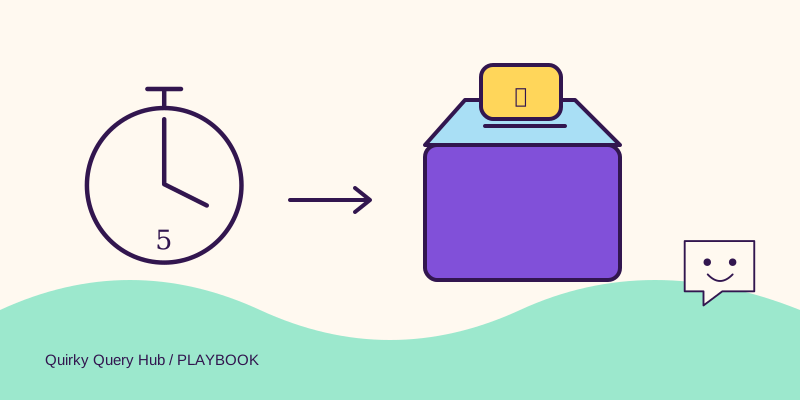
The question is already understood: “Why does the imaginary library need slippers?” For twenty seconds, two players think privately. During the next twenty, each records one short invented answer. During the final twenty, they read the answers. The minute ends there. Any voting, explanation, or longer story happens afterward, outside the timed challenge.
That is the whole timing promise. It is a small creative exercise for one person or a pair, not a guarantee that twelve people can submit, hear every answer, debate a winner, and move to the next question in sixty seconds. If your group needs longer, announce a longer round. An honest two-minute activity is more useful than a one-minute label that makes the final writer feel late.
The Wrong Answers Only tool collects submissions and then votes at the group's pace. It does not enforce the three twenty-second intervals described here. These are manually timed variations. Use a timer only where it is convenient, agree that anybody may stop, and keep the invented explanations clearly separate from factual instruction.
Choose the smallest complete unit
For this format, the unit is one prompt plus one short answer per willing participant. Read the prompt and explain any unfamiliar word before starting the minute. A long introduction should not consume a player's thinking time. Use an example from a different question if needed, so the demonstration does not become the answer everybody feels expected to imitate.
Set an answer size that fits the reveal: one sentence or a compact phrase. The purpose of that boundary is to leave room for both participants, not to test typing speed or penalize spelling. A phrase such as “to sneak past sleeping dictionaries” is complete enough for the library-slippers prompt. It connects the footwear to an invented reason without requiring a full scene.
Choose a response method before starting. A solo writer can jot one line. Two people can use separate notes and reveal them together, or take agreed turns entering short responses on a shared device. Passing a device, changing keyboards, or explaining controls takes time. If the method cannot fit the submission interval comfortably, change the method or lengthen the activity before calling it a one-minute challenge.
Run the three stages literally
From zero to twenty seconds, think privately. Do not fill the interval with the host's own possible answers, hints, countdown commentary, or jokes. Those interventions make it harder to form an independent idea. A player can use the whole interval to choose a single detail, and thinking does not require an appearance of intense concentration.
From twenty to forty seconds, record the answer. In a manual pair version, both can write simultaneously. On a shared device, one can enter the first short response and pass it promptly for the second. If somebody is not ready or does not want to submit, stop treating the minute as a completed competitive round. The timer is not authority to invent their answer for them.
From forty to sixty seconds, reveal and read. Read each line plainly, without adding a second joke that makes one submission seem stronger. For a pair, two short answers leave some room to understand the images. If the answer needs a long explanation, save that discussion for after the signal rather than stealing the other person's reveal time.
At sixty seconds, say that the creative minute has ended. The players may choose a favorite, ask a connected question, revise, or stop. None of those actions is secretly included in the original minute. A stopped timer is a boundary between activities, not an instruction that a conversation must abruptly end mid-sentence.
A worked library-slippers minute
The following demonstration is fictional. Lin and Marta choose the manual version with separate scraps of paper already available. Their host reads the library question, confirms that the building is imaginary, and states the one-sentence limit. The host uses a different example beforehand: an imaginary fence wears a scarf because its posts are feeling formal.
During the thinking interval, Lin considers shelves tiptoeing and chooses dictionaries as the sleepers. Marta imagines the building going for a walk. Neither hears the other's idea. This matters because the second writer should not have to invent a response under the shadow of the first answer's public reception.
During submission, Lin writes “The shelves wear slippers to tiptoe past sleeping dictionaries.” Marta writes “The library is visiting a house where outdoor shoes are not invited.” Both stop after one sentence. They do not add explanations of who lives in the house or how a whole building travels; those are possible future stories, not required parts of this answer.
During reveal, the host reads Lin's line and then Marta's line with comparable attention. The minute ends. Lin wants to hear more about the visiting library, while Marta likes the image of sleeping dictionaries. Their preferences cross, so they simply discuss both. No hidden audience score, sudden tiebreaker, or claim about who is more creative is needed.
If they want a competitive browser round later, they introduce its actual submission and voting sequence as a separate format. A vote after the minute can be perfectly legitimate when announced; it just belongs to the following activity. The timing record should say “creative minute plus optional discussion,” not describe the whole exchange as sixty seconds if it lasted longer.
Five prompts with two different answer routes each
“Why does an imaginary staircase keep a diary?” One answer is “It wants a record of all its ups and downs.” Another is “The landing keeps borrowing its memories.” The first uses an expression connected to stairs; the second turns part of the staircase into a character. Both keep a visible link to the question without requiring the writer to know a particular reference.
“Why has a fictional teacup hired a translator?” It might want to understand what the saucer means by silence. Or it might need somebody to translate a handle's dramatic gestures. One response treats a relationship as conversation, while the other reinterprets a shape as action. These are examples to discuss after a practice round, not lines to require players to improve upon.
“What is the secret purpose of an imaginary bus ticket?” It might be a permission slip for yesterday to leave town. It might reserve a seat for the journey's ending. The ticket remains a small concrete item while its job changes. Nobody needs to describe a real route, produce travel records, or show the contents of a wallet.
“Why has an imaginary garden gate joined a choir?” It could want to learn how to open on the right note. Or the hinges could be tired of singing alone. Both provide a short answer with a potential second scene. There is no physical demonstration, gate handling, or required singing in the challenge; describing the invented reason is the entire task.
“What does a fictional eraser keep in its savings account?” Possible answers include unused apologies and small pieces of yesterday's weather forecast. The first relates erasing to correcting a mistake; the second invents a material the eraser could remove. A writer may choose a completely different direction. Two samples show breadth rather than establish the acceptable solutions.
Choose one prompt for an actual minute. Reading all five first can overload a short activity and encourage players to prepare answers while you are still explaining. Keep the others as reserves. If a question fails because its central object is unfamiliar, replace it openly before the clock starts rather than turning recognition into an accidental knowledge test.
Change one condition and see what happens
After a first round, offer a second with a different constraint. “Give a reason” can become “write a notice from the object” or “state its one rule.” For the staircase, a notice might say “Please leave spare endings on the landing.” The output has changed, so participants have a new task rather than a demand to produce a better version of their first joke.
You can keep the twenty-second stages while reducing the expected output to a phrase, provided everybody agrees. Conversely, if people want miniature stories, extend the schedule and give the activity a new name. A four-line scene is not automatically a failed one-sentence response; it may be a sign that the group wants a different kind of exercise.
Do not introduce a surprise banned word, rhyme requirement, or penalty after thinking begins. Late restrictions invalidate the brief people were working on. If the host has a new idea, save it for a later round. The point of a time boundary is a known creative frame, and that frame includes the instruction as well as the duration.
When sixty seconds does not fit
A larger group creates a real capacity problem. Twelve answers cannot receive the same comfortable attention as two within a twenty-second reveal. Split into voluntary pairs for separate manual minutes, then offer a later showcase, or run an untimed full-group round. Do not choose only the fastest writers for the reveal without having announced that limited arrangement.
Device entry can also become the bottleneck. A shared keyboard introduces a sequence even when thinking happened simultaneously. If handoffs consume the interval, use separate notes if available or remove the submission deadline. The hardware does not tell you anything meaningful about who has the stronger idea. Avoid calling a typing delay a creative failure.
Reading and language preferences matter to the format. A player might prefer to dictate a short line, use a familiar language with an agreed translation, or think longer. Arrange that before starting if possible. If a minute does not serve the participants, an untimed variation retains the interesting question without keeping a limit that contributes little to the actual activity.
An interruption ends or pauses the exercise according to what people need. Do not quietly add ten seconds while announcing that the original minute remained intact. You can say “We restarted after the interruption” or “That was an untimed practice.” Accurate labels make later comparisons understandable without suggesting that every creative session needs a formal performance record.
Separate revision from the timed attempt
After the minute, invite one concrete edit. A vague answer such as “because it has a job” can gain a specific action: “because it files complaints from crooked sentences.” The object now participates in a picture. This is a revision example, not evidence that the original writer should have reached that line faster.
If an answer is long, find the single relationship it needs. “The teacup has employed a professional translator because the saucer communicates in ways that the teacup has never learned” can become “The teacup cannot understand the saucer's silence.” A shorter draft may reveal the image, but length is not automatically a flaw outside the agreed timed format.
Ask the writer before revising their line publicly. They may want to explain it, leave it as it stands, or put it away. A supposedly helpful group rewrite can become several people replacing one participant's voice. For more deliberate practice, use Solo Wrong Answers Only Challenges and keep revision separate from voting.
Add voting only after explaining its rules
In the current browser game, all configured players submit nonempty answers before the shuffled reveal and voting stage. Each configured player casts one vote. The interface permits self-voting, so a no-self-voting agreement is a manual convention rather than an automatic restriction. After the last vote, every writer tied for the highest count receives one point.
Anonymous display conceals names during comparison but does not guarantee unrecognizable authorship, and the final result names winners or tied winners. Explain that before promising privacy. The browser also maintains local state. Do not claim the minute deletes submissions, produces an automatic humor rating, or keeps identities permanently hidden. Article examples are manual prompts rather than an automatic bank import.
If someone declines to submit, do not force an answer to satisfy the configured roster. Pause and choose another arrangement. This short challenge can be unscored, and a person may listen without being recorded as a competing slot. For arithmetic examples, see How to Score a Wrong Answers Only Game. The creative limit and the scoring method answer different questions.
Prepare the next minute from what actually happened
After a round, inspect the brief rather than rank participants by speed. Was the object recognizable? Did the wording suggest more than one direction? Could both answers be read within the reveal? Did the device handoff fit? These observations identify whether the next change belongs in the prompt, response length, timing, or group arrangement.
Save one useful adjustment, such as “read the question before timing” or “use pairs for the reveal.” You need not preserve every response or build a league table. If players want a longer conversation about the fictional library, let the timed challenge become that conversation instead of interrupting it for another minute on schedule.
For broader hosting advice, read How to Host a Funny Answer Competition. For writing new prompts, use How to Write Interesting Questions People Want to Answer. A reproducible minute has an understandable prompt, three honest stages, and an ending that leaves further play optional.