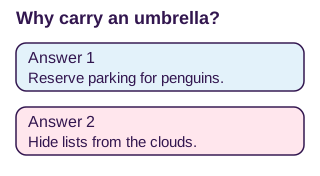
A completely unrelated answer is easy to produce. Ask why a kettle whistles and somebody can write “Tuesday.” The reply is incorrect, but it gives the next person almost nothing to picture. A more satisfying wrong answer keeps one part of the ordinary world recognizable and bends another part: the kettle is practicing its announcement for a very small railway station. Now there is a noise, a reason for the noise, and an unexpected institution taking itself seriously. The sentence offers a miniature world rather than a random interruption.
Wrong Answers Only Arena gives that kind of invention a social shape. Players receive an ordinary question, submit their own responses privately, and then vote on the collected entries. Anonymous display is available, so the idea can arrive before its author does. The browser counts ballots; it does not know which sentence is clever. That division matters. The machine can preserve a fair submission sequence, while the people decide what kind of joke makes sense in their room. A surprising tally is a starting point for discussion, not a verdict about somebody's talent.
A useful connection beneath the nonsense
Think of a wrong answer as a bridge with one end still attached to the question. If the question concerns a familiar object, preserve its shape, sound, location, or normal movement. Then give that feature a different purpose. A drawer might store unfinished echoes because it slides shut on them. A traffic cone might be a hat reserved for extremely cautious giants. The explanation is invented, but its connection is visible. A listener can reconstruct the joke without being told that an arbitrary word is supposed to be funny.
That connection also gives hesitant writers somewhere to begin. They do not have to outdo the most theatrical person in the group. They can notice one literal detail and ask what else it resembles. The best starting question is often “What would this look like if it had a job?” Another is “Who would need this feature for a completely different reason?” Neither guarantees a winning answer. Both create a manageable task that can be finished in a sentence, which is more useful than asking everybody to be hilarious on demand.
Fictional Example: the station that fit inside a kitchen
The following story is invented to illustrate hosting and writing decisions. Its kettle question is a paper warm-up, not a promise that the exact prompt appears in the live bank. Four neighbors are waiting for a community-room oven to finish warming. They have met several times, but one participant, Mara, usually leaves the jokes to her louder neighbor, Ellis. The host suggests a single written round while they wait. Each person gets the same question: “Why does a kettle whistle?” They agree to keep replies short and to hear every entry before discussing authorship.
Ellis immediately announces that he has an excellent answer. The host asks him to keep it private until the reveal, explaining the same rule to everyone rather than singling him out. This small interruption changes the room. Mara has time to look at the kettle instead of responding to somebody else's performance. She notices the steam, the handle, and the rising sound. Her first thought is a dragon with a cold. She crosses that out because it feels like a creature pasted onto an object. Then she writes that the kettle is announcing departures from the kitchen railway station.
The host collects four answers on paper and numbers them. One says the kettle is warning the teaspoons about a flood. Another says it is auditioning for a flute orchestra. Ellis has written that it is complaining about being asked to work before breakfast. Mara's station answer comes last. The host reads all four in an even voice. Nobody is asked to explain yet. The group gives each response a brief look, then writes down one favorite independently. That pause is important: the person who laughs first does not automatically set the room's choice.
The first count produces a tie between the complaining kettle and the tiny station. Ellis thinks a second ballot would settle it, but the host reminds the group that they agreed to one round while the oven warmed. They keep the shared result. Once the authors are named, Mara explains that the steam suggested a train. Another neighbor adds that the bread bin could be the waiting room. For a moment the entire counter becomes a transport network. The joke grows through details people can see rather than through louder claims about whose answer deserved to win.
There is a useful turn in this story: the quieter writer contributes the premise that other people want to develop, but she does not need to perform a comic monologue to earn that space. The host has not made quietness into a problem or praised her as an unexpected exception. The submission procedure simply gives her a completed sentence before the group begins reacting. Ellis still contributes an enjoyable answer. The difference is that his confidence no longer determines the available thinking time for everybody else.
In the browser, the host can use the actual question drawn by the tool and keep the same social procedure: read it, pass for private entries, wait for the submission phase to finish, then let each voter choose. The exact kitchen question can remain a separate paper exercise if it is not on screen. Do not claim the app accepts a new custom prompt unless that control is actually offered. What transfers from the story is the protected sequence, the neutral reading, and the willingness to let a tie remain a perfectly usable ending.
Why the reveal sometimes changes the joke
Anonymity protects an answer from some expectations, but it is not magical secrecy. Friends may recognize a favorite phrase, and a player may give themselves away by laughing. There is no need to interrogate the room about those accidents. Ask people to avoid announcing ownership and continue. A light game becomes tiring when its host polices every facial expression. The purpose is to give an entry a chance to be heard, not to create a courtroom standard of author concealment.
The reveal can also create a second layer of interest. A careful person may write the most extravagant sentence; somebody known for elaborate stories may choose a very plain wrong explanation. Invite authors to describe one choice in their wording if they want to. Do not require a defense of the vote count. “I used the sound as my starting point” helps other writers borrow a method. “Explain why nobody voted for you” turns the same moment into an unwanted assessment. The distinction is small in wording and large in effect.
Illustrative Scenario: a workshop that stops chasing laughs
This second example is also fictional. A small writing workshop uses an offline exercise about the purpose of a doorbell. Their goal is to practice concise invention, not to crown the funniest person. Each writer produces one wrong explanation. A participant writes that the bell is a tiny elevator for visitors' names. Another describes it as a rehearsal button for thunder. A third submits a long account of a retired mountain learning manners. The group initially chooses the longest answer because it contains the most incidents, even though several people cannot explain its connection to a doorbell.
Instead of running another popularity vote, the facilitator changes the task openly for a separate practice round. Writers keep their first answer and underline the concrete detail that links it to the object. The mountain writer notices that the knock-and-response idea disappeared halfway through the paragraph. She shortens the response to a mountain politely announcing that it has arrived. The image is still impossible, but the doorbell now matters. Other writers revise too. The elevator answer gains a destination; the thunder answer loses an extra joke that distracted from the first one.
This is a revision workshop, not an automatic feature of the Arena. In the live tool, the ballot still records the group's favorites. On paper afterward, people can compare a first sentence with a revision without pretending that either version has received an objective humor score. The workshop ends by reading one pair of drafts aloud. Nobody is required to reveal a vote. The useful result is a clearer relationship between image and question, demonstrated through actual words rather than through an abstract instruction to be more creative.
The two scenes ask different things of a host. The kitchen gathering needs a quick, low-pressure encounter that can stop when the food is ready. The writing group needs space to revise and name a technique. Trying to run both at once would muddy the experience. Announce whether the next round is a friendly ballot or a learning exercise before collecting entries. People can enjoy either, but they should not discover after submitting that the host has quietly changed the criterion from amusement to technical writing quality.
Editing a sentence without explaining it to death
A wrong answer often improves when its writer removes the sentence that explains why it is funny. If a pencil is a staircase for an exceptionally narrow ant, the audience can already imagine the scale. Adding a paragraph about how ants are small makes the picture less lively. Use enough information to make the invented purpose legible, then stop. This is not a demand that every response be extremely short. Some ideas need a condition or a consequence. The practical question is whether each additional phrase gives the reader something new to see.
Specific nouns tend to help more than general enthusiasm. “A committee of teaspoons” creates a different scene from “a very weird group of things.” A precise verb can do similar work: the committee inspects, protests, retires, or misfiles. Choose one action that fits the invented explanation. A sentence containing four disconnected transformations may force listeners to rebuild the world repeatedly before reaching the point. A single coherent absurdity gives them room to make their own connection, which often produces more conversation than an answer that supplies every possible embellishment.
For a mixed-age group, read the normal direction of the question clearly before accepting wrong responses. A younger player who does not know what an unfamiliar object does has a different task from somebody deliberately reversing its use. Clarify the ordinary function without presenting a model joke that everyone then imitates. A child can dictate a sentence to a reader, and a writer who dislikes public delivery can let the host read it neutrally. These adjustments change access to the task while keeping authors responsible for their own idea.
Votes describe this round
The actual ballot reflects the entries, the question, and the particular voters. It cannot tell you which person is generally the most imaginative. A familiar running joke may receive more votes than an unfamiliar image because the group shares its history. A subtle answer may become clearer only after the reveal. Those are ordinary features of a social choice. Avoid converting a single local tally into a ranking of personalities, and be especially careful when a workplace or classroom group already has strong expectations about who is supposed to be funny.
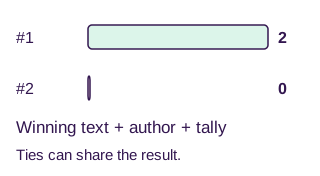
Ties are useful information rather than administrative failure. Two answers can appeal for different reasons: one makes an immediate visual connection, another gives the object an unexpected attitude. The Arena handles tied leading answers as a shared result. A host does not need to invent a secret tiebreaking rule afterward. If the group wants another ballot under a narrower criterion, make that a new, clearly announced activity. Do not retrospectively add penalties for length or familiarity after seeing which authors benefited from the original arrangement.
There is also a good moment to stop. If each new answer requires an explanation of an earlier joke, newcomers may have lost their way into the game. Draw a fresh ordinary question and let the room start from common material again. If people begin targeting an absent person or turning private information into the punchline, replace that direction with a fictional object or situation. The pleasure here comes from misdescribing the world together. It does not require making an actual participant less comfortable so that everybody else has something to react to.
Leave one small world behind
After the final reveal, ask which invented detail somebody would like to keep. The question is optional and has no points attached. A group may remember the kitchen station long after forgetting the ballot. That does not mean the scoring was pointless; it gave the round a clear finish before discussion opened. The useful rhythm is preparation, independent choice, reveal, then a little room for a detail to travel. Endless voting can flatten that rhythm, while discussion before submission can prevent quieter ideas from ever taking shape.
A host preparing the next gathering can keep a private note about the kind of question that worked, without collecting personal answers unnecessarily. Did the room like object purposes, tiny institutions, or impossible explanations of ordinary sounds? Use that observation to choose a future prompt rather than prescribing the same joke again. The most reusable part of a successful round is rarely its winning sentence. It is the combination of a recognizable question, protected thinking time, and a fair opportunity for each wrong explanation to become briefly believable.
Before leaving the table, let players decide whether any locally saved material should remain on the shared device. A favorite sentence may belong to its author even when it describes an imaginary kettle. Use the data controls thoughtfully, and avoid treating an exported backup as a souvenir to circulate without asking the people whose writing it contains.