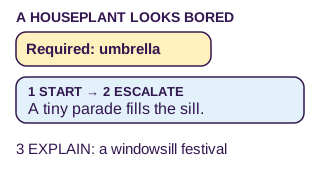
The funniest bad advice often understands the original problem perfectly. Somebody is late, a room is untidy, or an ordinary object refuses to cooperate. Instead of solving that small difficulty, the imagined adviser constructs a system that makes it elaborate. A late arrival becomes the chairperson of a committee investigating the concept of punctuality. The joke depends on recognizing the sensible solution that the plan keeps avoiding. Without that recognizable problem, three absurd sentences may be colorful, but they do not add up to advice.
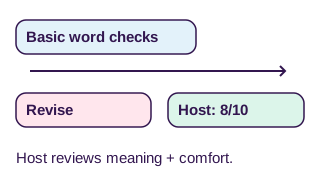
Bad Advice Battle develops a plan rather than collecting a one-line answer ballot. The player writes three steps around a situation and a generated constraint. A local check considers basic completeness, required wording, simple relevance and unsafe terms. A human host then reviews the actual meaning and assigns an integer score from zero to ten. Those are separate jobs. Passing a wording check does not establish that a plan is harmless, coherent, or funny. The host should still be willing to ask for a revision or decline a premise entirely.
Escalation is not the same as harm
A comic plan can become more complicated without becoming more dangerous. Its second step might introduce an unnecessary form, a ceremonial title, or an imaginary audience of objects. Those additions increase the character's commitment to the original mistake. They do not need injury, interference with somebody else's belongings, unwanted contact, or humiliation. A host who keeps that distinction visible gives writers more useful creative territory than a host who merely says that anything is allowed as long as it is called a joke.
Think about a three-step chain as action, consequence, and explanation. The explanation should reveal why the adviser considers the consequence a success. If the first step appoints a sock as an official spokesperson, the second might require every missing sock to file a complaint through it. The third can explain that silence proves universal satisfaction. Each move follows the same mistaken logic. There is a recognizable structure to admire even though the imagined recommendation is useless. This is different from appending three unrelated surprises to a familiar inconvenience.
Fictional Example: the umbrella at the rehearsal table
This invented workshop story illustrates plan development. Its rehearsal scenario and exact constraint are paper examples rather than a promise of a particular live draw. A small amateur theatre group is waiting for a missing prop list. Their organizer proposes a short bad-advice round about a fictional director who keeps losing the order of rehearsal scenes. The constraint is to include an umbrella. Everybody agrees that the plans will remain imaginary. Nobody will alter the real rehearsal schedule, move somebody else's materials, or impersonate a real team member as a joke.
Lena's first draft places an umbrella on the director's desk, calls it the assistant director, and ends by saying that rain has canceled the rehearsal. She likes the object but notices that her final step abandons the initial problem. The group was supposed to invent a terrible system for remembering the scene order. Canceling the entire activity is an escape from the premise, not a developed consequence. Before submitting, she asks what an umbrella could do that resembles arranging scenes. Its ribs give her a visible sequence around a central handle.
She rewrites the plan. First, the fictional director assigns each scene to a rib of an imaginary umbrella. Second, every time somebody asks what comes next, the director rotates it until the nearest rib points at the stage. Third, the director explains that any inconsistency is an experimental circular narrative and asks the cast to admire the method's flexibility. The advice now makes the rehearsal less predictable for a specific reason. The last explanation protects the ridiculous system rather than admitting that it has failed.
Another player, Oren, writes a more elaborate plan involving a messenger sent to collect missing instructions from people who are not at the rehearsal. The host pauses that version. Even though the scene is fictional, its suggested action closely resembles recruiting unwilling outsiders into a real game. Oren is invited to rewrite the messenger as a paper silhouette that visits drawn doors on a map. He keeps the excessive bureaucracy but removes the implied instruction to contact actual people. The host is reviewing the action, not merely searching the plan for an alarming word.
When the host scores the plans, Lena receives a strong review for a clear link between the object, the confusion, and the final excuse. Oren's revised entry receives credit for a coherent imaginary process, with a note that the first step needed a more visible connection to scene order. Neither number is presented as a measurement of creative ability. The host states the criterion that was announced before writing: connected escalation within the situation. If the next round uses a different criterion, it will be named before the new submissions begin.
The story has two important turns. Lena improves her own joke by returning to the original problem; Oren improves his by changing what the proposed action actually involves. Neither improvement requires a harsher event. The plans become more specific and more playable as they become less careless. A host can borrow that distinction with a simple revision request: keep the mistaken system, but change the real-world action into a clearly imaginary one. If the revised premise still feels uncomfortable to a participant, moving to a different situation is easier than arguing for the right to keep it.
Put the required word to work
A generated word can feel like an obstacle when it is merely attached to the last sentence. “Also bring an umbrella” satisfies a surface instruction but may contribute nothing to the plan. Try giving the word a role: the object becomes a measuring instrument, an authority, a witness, or an unnecessary procedure. This is a writing technique, not a claim that the app can recognize whether the integration is elegant. The host has to read the actual steps and decide whether the object participates in the same logic as the situation.
Do not penalize someone for using a small connection when a clear one is enough. A constraint does not have to dominate all three steps. It may provide the first mistaken idea that the remaining steps develop. The useful question is whether removing the constrained element would leave the plan essentially unchanged. If the answer is yes, the writer has probably treated it as decoration. Invite a revision that gives it one consequence. That invitation teaches a specific choice instead of asking for a vague increase in originality.
The browser's local vocabulary check is also limited. A plan can mention the situation's words without addressing its difficulty. Conversely, a clever indirect description might need clearer wording to pass. Do not tell players that the screen has understood their story. Explain what the check actually requires and let the human review handle coherence. If someone is frustrated by the wording requirement, shorten the draft and state the connection plainly before rebuilding the joke. Avoid presenting a software constraint as an infallible literary judgment.
Illustrative Scenario: a solo editor discovers a broken third step
In this second fictional case, a solo writer uses an offline exercise about an imaginary librarian whose returned books keep arriving in the wrong order. Her draft tells the librarian to sort them by how loudly their titles sound, appoint a silent book as chief inspector, and finally declare the entire library a musical. Each sentence has an amusing image. Yet when she reads the sequence aloud, the third step no longer explains the failure of the first. It starts a different scene. The draft feels busy because it keeps changing what kind of mistake is being made.
She rewrites only the ending. The librarian now explains that a quiet shelf is proof that the loudest books have accepted their assigned places. The silent inspector matters because it never objects. The final excuse grows from the sorting rule rather than replacing it. To test the sequence, she asks what information a reader needs at each step. The first supplies the mistaken criterion, the second gives it an absurd authority, and the third turns the lack of protest into evidence. A shorter plan now contains more connected comic work than the longer version.
This exercise does not require pretending that solo writing has an independent judge hidden inside the tool. A writer may use a paper review or ask another willing reader for feedback. In a live group, the designated human host assigns the actual score. The solo editor can still learn from the three-step structure by comparing drafts and keeping a note about the change. Her useful discovery is not that a program has certified the new joke; it is that she can explain why its ending belongs to the same invented system.
The contrast with the rehearsal story is deliberate. One group needs fair turns, a shared review criterion, and an immediate safety rewrite. The solo editor needs a way to diagnose a broken connection without another person supplying the answer. Both use the same three-step form, but they use it for different purposes. A host planning an evening should decide whether the group wants quick competition or a slower writing workshop. Switching between those goals without explanation can make a careful revision feel like an unwanted delay in a game that everybody expected to keep moving.
Human review should be specific enough to help
Choose one main creative criterion before the first plan is written. It might be connected escalation, economical wording, or a convincing final excuse inside the fiction. Avoid a hidden blend of every possible preference. After a score, a host can name one successful link and one place where the plan lost its premise. That is more useful than declaring an entry a seven because it was “quite funny.” The number records a local decision. The short explanation gives the writer something concrete to understand about that decision.
Safety is not an extra point category that a player may trade against creativity. A plan that asks for an unacceptable action should be revised or skipped, even if its wording is inventive. A host should not award a high joke score and subtract a token point for involving an unwilling outsider. The problem is the proposed participation, not a small flaw in technique. Keeping the boundary separate from the creative review makes it easier to apply consistently when a popular writer submits an idea that the group would otherwise be reluctant to challenge.
The host also needs a way to avoid endless debate about the score. Let an author clarify an ambiguous sentence once, then either accept the review or revise the plan under the stated process. A party round is not an appeal hearing. If people would rather compare versions than accumulate points, make the next activity an unscored workshop. The software's host-score field can support a game, but its existence does not require every gathering to treat a numerical judgment as the most interesting result of writing together.
Small problems give the imagination room
Begin with inconveniences that participants can picture without personal disclosure. A fictional meeting starts late, an office plant demands a job title, or a queue refuses to form a straight line. These premises make the contrast with a sensible solution visible. Avoid asking people to explain a recent real failure as the price of receiving a scenario. The game is about building a comic mechanism. It does not need somebody's distress to make the starting problem feel legitimate.
For mixed writing confidence, give everyone a moment to identify the normal solution privately. They do not have to submit it. Knowing that a sensible adviser would simply check the list or ask a clear question helps a player see what the bad plan is avoiding. A host can then demonstrate a tiny harmless escalation without writing a complete model that everyone copies. Let someone dictate their own three steps to a reader if typing is the obstacle. The reader should preserve the idea rather than quietly substituting a more polished joke.
When several plans use the same device, such as appointing an object to a committee, do not demand novelty for its own sake. Ask what each committee actually does. One may delay a decision, another may collect meaningless evidence, and another may certify its own existence. If the mechanism is identical, a new situation or constraint can help. If the consequences differ, the shared comic device may simply be a useful form the group is learning to handle. Repetition becomes unhelpful when it replaces a connection rather than when a familiar technique appears again.
A good ending admits what the game did
The round ends with a reviewed fictional plan and a local host judgment. It has not produced real advice, established a safety guarantee, or measured anybody's general intelligence. Those limits do not make the result small in the room. A group may have discovered a way to turn a loose joke into a connected sequence. A writer may have learned to repair an ending. A host may have demonstrated that a boundary can be enforced through a concrete rewrite instead of an embarrassing public argument.
Keep the last discussion close to the words people wrote. Which step made the original problem harder in a recognizably absurd way? Which final explanation almost sounded plausible until somebody pictured it? One or two observations are enough. Then let the next player or situation begin, or stop while the invented logic is still enjoyable. The pleasure of this game lies in watching a bad system commit to itself. Its best plans are terrible solutions to small fictional problems and carefully constructed pieces of shared writing.