Put six unlikely objects on a table and ask which would make the best receptionist. An argument may begin before anybody moves the first item. Does “best” mean welcoming, efficient, impossible to ignore, or able to remember a visitor's name? A bell might dominate one version of the task and fail another. This is the interesting territory of a ranking game: not a hidden correct sequence, but the small assumptions that make one sequence seem obvious until somebody else offers a different one.
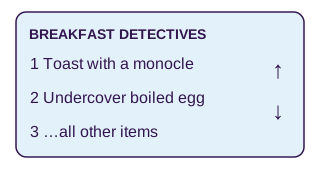
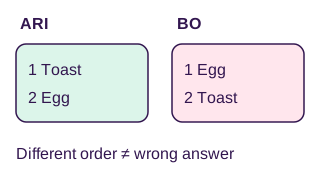
Ridiculous Ranking Showdown makes a complete order visible. Players rearrange the same items, submit their lists, and inspect the comparison after the entries are collected. Moving one favorite to the top is only part of the task. Every other item needs a place too. The result can expose a disagreement that a single-choice vote would conceal. Two people may share the same first item while putting the rest in almost opposite order, or disagree about the winner while arranging nearly everything else alike.
The criterion is part of the material
A ranking becomes a conversation when its criterion is concrete enough to apply and open enough to interpret. “Best object” is usually too loose; “best object to greet a confused visitor at a fictional museum” gives people a job to imagine. They can still disagree about whether a pleasant welcome matters more than clear directions. The disagreement has somewhere to go because everyone can refer to the same task. A vague superlative tends to produce declarations of taste, while a specific task invites reasons that other people can examine.
Do not close every ambiguity before the first submission. Clarify what is necessary to make the premise workable, such as whether the objects can speak in this fictional world. Then let some priorities remain individual. If the host supplies a full scoring rubric for every item, there may be little left to discuss. Conversely, if each player silently imagines a different job, the reveal can feel arbitrary. The useful middle is a shared situation with room for people to decide which difficulty deserves the most attention.
Fictional Example: the museum opens ten minutes late
This invented story uses a paper ranking exercise. The exact list is not presented as a live bank entry. A volunteer team is planning a small fictional exhibition called the Museum of Misplaced Things. While waiting for a room key, six people rank imaginary receptionists: a folding chair, a metronome, a scarf, a magnifying glass, a watering can, and a paper lantern. The question is which would best welcome a visitor who has entered the wrong building. They agree that each object may speak but must otherwise keep its ordinary physical abilities.
Nico chooses the lantern first because the visitor needs to notice someone helpful immediately. Sal puts the chair first because a confused person might want to sit while working out where to go. Their teammate Jo puts the magnifying glass at the top, imagining a receptionist who carefully reads the address on a ticket. The metronome comes last for nearly everyone at first glance. It appears to offer nothing beyond a regular noise. Each person writes a complete private list before the discussion begins, so these initial judgments do not settle the group order by imitation.
When the lists are revealed, the shared bottom choice seems to be the simplest point of agreement. Then Jo explains that she placed the metronome second. She imagines the wrong-building visitor becoming anxious while the queue grows. A calm repeated beat could help the receptionist give directions at an unhurried pace. Nico objects that a beat cannot read a map. Jo agrees, but points out that their fictional objects can speak: the question is not whether they can obtain directions, but whether they can deliver them in a reassuring way.
That clarification changes the character of the conversation. The group had not disagreed about the metronome's shape. They had assigned different weight to a visitor's emotional state. Sal still prefers the chair, because a resting place offers immediate help without needing to guess whether a sound will soothe or irritate. Nico keeps the lantern first but moves the scarf higher in his imagined revision, seeing it as a visible guide through a crowded entrance. Nobody is asked to surrender the first submitted list. It records an interpretation at a particular moment, not an error that must be corrected.
The host asks each person to name the single pair they found hardest to order. This prevents the most talkative volunteer from defending six choices while everyone else waits. Sal compares chair and watering can: one gives a place to pause, while the other might help a weary plant but not the visitor. The absurd premise stays useful because the explanation has become specific. The group finishes when the actual room key arrives. Their final shared idea is a welcome desk with both a visible sign and somewhere to sit, but the game has not magically produced a real exhibition design consultation.
The story's turn is a low-ranked item gaining a plausible role when someone identifies a neglected need. A host can borrow that question without borrowing the fictional list: “What problem does your second choice solve that the others missed?” It is a more productive invitation than asking a player to justify why their order is so strange. The wording treats a difference as information. It also keeps discussion attached to an item and criterion, rather than turning a ranking into a diagnosis of the person who submitted it.
Reading distance without inventing a winner
The browser comparison measures how far positions differ from the first submitted ranking. That first list is a reference, not an official answer. A player whose list matches it has zero position distance; a larger total indicates more disagreement with that reference. It does not show weaker reasoning, worse taste, or a lower standard of creativity. Say this before collecting entries if the group is likely to interpret every number on a screen as a score to maximize.
A numerical comparison can start the conversation, but it cannot finish it. Suppose two players exchange the top and bottom items while keeping the middle positions alike. Another pair may move several neighboring items by one place. Both patterns contribute to distance, yet they feel different when discussed. The first points to a sharp dispute about an item's role; the second suggests many small uncertainties. Expand the saved lists and inspect the actual orders instead of treating one total as a complete account of what people believed.
Avoid making the first submitter the unannounced judge. If someone asks why everyone is measured from that list, explain the interface's comparison convention plainly. You can also discuss any two visible lists on their own terms. There is no need to calculate a new unofficial winner to make the discussion fair. For a group that wants a different reference in a later round, change who submits first openly rather than silently altering the meaning of a completed result.
Illustrative Scenario: two remote friends compare their middle choices
This separate fictional example is a paper-and-call adaptation, not a claim of online multiplayer synchronization. Two friends, Priya and Ren, are speaking over a video call. One shares a fictional list of objects to take to a meeting of extremely polite ghosts: a notebook, a thermos, a scarf, a bicycle bell, a mirror, and a cushion. Each writes a full order privately. Their first choices match, so Ren initially assumes that the lists will be almost identical. The notebook seems useful for recording requests that the living cannot hear clearly.
The reveal shows that the middle matters. Priya puts the mirror second because it gives the ghosts a way to see whether they are accidentally frightening visitors. Ren puts it last because he imagines that ghosts do not appear in mirrors. They have imported different fictional rules. Neither assumption was specified in the prompt. Rather than argue that one version is established ghost science, they make the rule explicit and preserve both original lists as examples of the difference. The next round will state whether the mirror works for its intended users.
Their most interesting agreement turns out to be a shared fourth-place cushion, chosen for opposite reasons. Priya thinks a cushion is hospitable but not very informative. Ren thinks it could mark an empty chair so nobody sits through a ghost, but it may also confuse a visitor. The same position does not imply the same rationale. They finish by choosing one item each would move if the guests were impatient rather than polite. This small counterfactual keeps the activity light while testing whether their reasons actually depend on the scenario.
In the browser version, one person can manage a shared local device when everyone is present. On a remote call, decide explicitly how people will send orders and who will enter them; the site does not promise that distant browsers share a room automatically. Preserve each person's opportunity to make an independent choice before the host reads another order aloud. The practical lesson from this case is about information order, not about pretending the tool has a collaboration service it does not provide.
One change at a time
After a reveal, a host can offer a second criterion and ask which single item moves most. Keep the original list visible or noted before beginning that discussion. A receptionist chosen for a calm visitor may differ from one chosen for a noisy crowd. The exercise becomes sharper when only one condition changes. If the host changes the setting, the objects' abilities, the audience, and the available time simultaneously, players cannot tell which change caused their revised judgment. A small counterfactual makes a reason easier to test.
This is optional conversation around the completed ranking, not an extra automatic scoring phase. The live tool supports another round, but its next draw may provide new material rather than the host's precise revised criterion. If you want to revisit the exact old list under a new condition, do that as a clearly labeled paper discussion or compare the saved lists. Distinguishing the recorded result from an imagined variation prevents a helpful hosting idea from becoming a misleading description of an interface feature.
For younger players, reduce the verbal burden before reducing the importance of their choice. Ask them to explain one surprising placement rather than all six. They might point to an object and describe a short scene in which it helps. A reader can say the list aloud, and a partner can move items according to the child's instructions. The partner should not quietly replace an order they think is less sensible. The point is to preserve the player's decision while changing how that decision reaches the shared display.
The physical order should not become the argument
Dragging can be convenient on one device and awkward on another. The tool also offers Move up and Move down controls, including keyboard access, so ordering does not have to depend on a precise gesture. Give someone time to check the final sequence before submitting. A misplaced row is not a revealing preference, and a host should not build an interpretation around an accidental drop. Read the top and bottom choices back when somebody says the controls felt unfamiliar, then let them confirm what they intended.
The same care applies to private submission. If the next player sees an earlier list and wants to imitate it, do not treat them as dishonest. Explain that independent orders make the comparison more interesting and give them a fresh moment to think. With a group that prefers open collaboration, a single shared ranking can be a worthwhile paper activity, but it answers a different question. A negotiated list records what the group could agree to say together; separate lists record which differences existed before negotiation.
Some participants enjoy defending their last choice because it creates a dramatic reversal. Others find that their middle positions are nearly interchangeable. Allow both experiences. Forcing a detailed explanation of every neighboring pair can turn a playful comparison into an examination. Ask where the player felt confident and where they were merely making a necessary ordering decision. That distinction makes the reveal more honest. A full sequence contains precise positions even when the underlying preferences are not equally precise.
End with a reason worth borrowing
A good closing question asks which explanation changed how someone pictured an item. It does not require anyone to change their submitted list. Perhaps the metronome remains an unsuitable receptionist, yet the idea of pacing directions becomes memorable. Perhaps the mirror still stays last, but the group now understands that it must agree on a fictional ability before comparing its usefulness. These are modest gains. The game does not need to reveal a profound truth about personality to justify the conversation it created.
When preparing another round, look for a fresh conflict between useful qualities rather than merely stranger objects. A criterion that gives speed, care, visibility, and discretion different roles can produce more varied orders than a list where one object obviously does everything. Keep the premise explainable in a sentence, collect complete independent lists, and reserve a little time for one unexpected placement. The lasting value is not the reference distance. It is hearing a clear reason for an order that, a moment earlier, seemed impossible to understand.
A final practical check is to separate remembered reasons from remembered positions. If someone returns to a saved list later, they may no longer recall why the scarf outranked the lantern. Invite an optional brief note outside the game when that explanation matters. Do not assume the tool automatically preserves every spoken justification merely because it saves the submitted ordering.