An ability sounds impressive until somebody asks where it can be used. A character who can make any chair wonderfully comfortable might be welcome in a waiting room and inconvenient on a crowded train. Add a requirement that they must sing the chair's full history before activating the power, and the useful gift changes again. The limitation is not merely a joke attached to a heroic label. It changes the situations in which the ability is worth having, which is where a good superpower discussion begins.
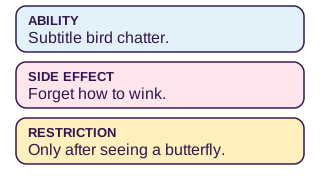
Worst Superpower Lab combines an ability, a side effect and a restriction. Players give separate usefulness and absurdity ratings and make a separate keep-or-reject choice. Those measures can disagree without anything being broken. A power may be extremely silly and still useful for one narrow job. Another might be broadly useful but too irritating for somebody to keep. The tool records opinions about a complete combination. It does not contain a hidden correct judgment about what an imaginary person ought to want.
Start with a job rather than a grand ranking
“Useful” needs a situation. Delivering an invitation, finding a dropped earring, or welcoming visitors gives a group a task to test. Without one, players may silently imagine different worlds: one thinks of everyday errands, another of rescuing a kingdom, another of avoiding household chores. Their numbers then appear to contradict each other when they are actually answering different questions. Agreeing on one job does not eliminate disagreement. It makes the disagreement easier to understand because everyone can refer to the same difficulty.
Keep the job modest enough that ordinary details still matter. An unlimited ability placed against an unlimited emergency often produces a debate about invented exceptions rather than a useful comparison. A restricted power tested against a small task lets players notice things such as noise, timing, hands occupied by an object, or a trigger that is awkward in the chosen setting. Those details give the fictional catch something to do. A limitation that never affects the task is decoration; a limitation that makes every use impossible leaves little room for inventive application.
Fictional Example: a very quiet delivery
This invented story uses a paper-designed combination. It is not a claim that the precise ability appears in the live random bank. A group of friends imagines a courier who can make written invitations float toward their intended recipients. The side effect is that every floating envelope hums a tiny tune. The restriction is that the courier must keep one hand on a wooden surface. Their fictional job is to deliver invitations during a quiet rehearsal without interrupting the performers. They agree to judge the whole combination, not just the appealing floating-envelope ability.
At first, Emil gives usefulness a high score. The invitations can find people without a courier walking between rows. Nora gives a low score because the hum would violate the most obvious requirement of the job. Their friend Dev is interested in the wooden-surface restriction: a hand on the stage rail might let the courier move along the edge, but a gap in the rail could end the delivery. The group has three different starting concerns. None of the players has failed to understand the power; they have noticed different parts of its operating conditions.
They test a single imagined route. The courier starts beside a wooden reception desk and releases one invitation toward a performer sitting near the back. The envelope hums. Emil proposes disguising the sound as part of the rehearsal music, but Nora points out that the group has not established any music in this scene. Adding a convenient soundtrack would solve the problem by changing the job rather than by using the power carefully. They keep the quiet rehearsal and ask whether the delivery can wait for an existing break in the activity.
Dev suggests that the courier use the floating ability only to organize the envelopes behind the desk, then hand them out during the interval. The solution uses less of the power than Emil imagined, but it respects the restriction and avoids sending humming paper through a quiet room. Nora now raises her usefulness rating slightly, while Emil lowers his because the power no longer replaces the whole delivery task. Both keep high absurdity ratings. The combination remains ridiculous even when a limited application becomes practical inside the fiction.
The keep-or-reject vote reveals another difference. Nora keeps the power because she likes a narrow, manageable trick. Emil rejects it because he would find the constant humming exhausting. Dev keeps it but wants to know whether the wooden surface must remain connected to the building. The host does not invent a universal answer after voting. They note that the restriction needs clearer wording for another paper test. The current round ends with three distinct opinions, a revised imagined route, and a question about an assumption that had gone unnoticed at the beginning.
This story's turn is the discovery that using less of a power can be a better response to the stated task. It does not prove that every inconvenience hides a gift. Some combinations really are poor fits for a particular job, and a player may reasonably reject them. The useful method is to try a concrete application before making a broad claim. In the live Lab, read all three generated parts, submit the separate ratings, and use the independent keep vote. If the group invents the courier combination, keep that clearly labeled as its own paper design exercise.
Separate an effect from a restriction
A side effect describes what also happens when the power works. A restriction describes when or how it may work at all. Confusing those roles can erase a catch accidentally. If a character's shoes squeak during an ability, that noise is a consequence to manage. If the ability works only while the character holds an empty cup, the cup is an activation condition. A plan that forgets the cup has not discovered a clever loophole; it has stopped testing the complete combination that the group agreed to consider.
This distinction makes imaginary design more satisfying. A writer can ask whether a catch changes the character's choices in a way a reader can see. A noisy effect may force a character to choose a time or location. A required object may occupy a hand or be easy to lose. The catch does not need to be punishing. It needs to matter. An inconvenience that can be ignored in every scene may be amusing for one sentence, but it offers little material for the next action in a story.
Avoid endlessly adding exceptions to rescue a favorite power. If it works only on Tuesdays, a player cannot assume that every difficult scene happens on Tuesday unless the group has chosen that context deliberately. If a new rule is appealing, make it a revised paper combination and compare it with the original. Keep the earlier ratings attached to the earlier version. Otherwise the discussion may appear to show disagreement between players when the combination has actually changed several times without everyone noticing.
Illustrative Scenario: the repair shop for imaginary abilities
In this second fictional case, a solo illustrator is designing a character for a comic rather than running a competitive party round. She invents someone who can remember the location of any misplaced button, but only after drawing that button from memory. Her first sketch shows the hero triumphantly locating hundreds of objects at once. The scene looks impressive, yet the restriction has disappeared: drawing each button would take time and require the character to remember an object they may never have examined.
She narrows the task to finding the last button from a favorite coat before an imaginary evening performance. The character remembers its unusual edge because they had repaired the coat previously. Now the drawing condition has a concrete role. The power succeeds, but the illustrator adds a harmless side effect: every discovered button briefly changes the pattern of the character's scarf. The catch is visible in the drawing without turning the story into punishment. She can show a practical search and a small unwanted consequence in the same panel.
Her second scene tests failure rather than making the power stronger. The character is asked to find a plain button they have never seen. They cannot draw it accurately enough to activate the ability. Another character supplies a spare button instead. The hero remains useful without becoming the only possible solution to every problem. The illustrator keeps both scenes because together they define the ability's boundary. One successful task alone would have encouraged her to write a universal finding power whose limitation mattered only when convenient for the plot.
This is not a hidden authoring workflow inside the live tool. The illustrator can use a drawn combination as a prompt, record her own ratings, and then explore a separate design in a sketchbook. The browser preserves the generated combination and player judgments where offered; it does not inspect the comic's consistency. The transferable habit is to test both a successful use and a situation where the restriction prevents success. A fictional ability becomes more legible when readers can anticipate its limits instead of waiting for the writer to invent a new exception.
Why the two rating scales should stay separate
Usefulness and absurdity ask different questions. One concerns what the combination can accomplish under the agreed circumstances. The other concerns how strange, incongruous, or comic it seems to the player. A high usefulness rating does not require a low absurdity rating. A power that organizes socks by their favorite music may be both effective in its tiny world and wonderfully unnecessary. Combining the two scales into one supposed quality score would hide that tension, which is often the most enjoyable part of the conversation.
The keep decision adds a third question: would this particular player choose to live with the whole package? A person may rate an ability useful but reject its irritating side effect. Another may keep an almost useless trick because it suits a fictional hobby. Let them explain one reason without asking them to reconcile every number into a single logical formula. Personal judgments can be consistent with different priorities. What matters is that the player has considered the whole combination rather than voting on the power's name alone.
When comparing ratings, ask about the largest meaningful difference. If one player rates usefulness two and another eight, find the tasks they pictured. A disagreement may shrink once both imagine the same job, or it may remain because they value different costs. Either result is interesting. Do not pressure people to converge on a middle number merely to make the group appear agreeable. The point of collecting separate ratings is to preserve differences that a single public show of hands could flatten.
Build a scene around the catch
A good follow-up question places the character in a situation where activating the ability is possible but inconvenient. If activation is effortless, the catch disappears. If activation is impossible, the scene may end before the character makes a choice. The useful space lies between those extremes. A character who must hold an empty cup might have to choose whether to put down an important letter, ask a companion for help, or postpone using the power. Those choices give the limitation a social and practical shape.
Keep the events harmless and fictional. There is no need to test an imagined restriction through an actual risky action, deprivation, or embarrassment. The group can describe what a character would do instead of performing it. For younger players, draw the power, side effect and required condition as three separate symbols before discussing a use. That makes the complete combination easier to remember and gives a reader a way to point to the part their proposed solution has forgotten.
For a creative group, ask one person to describe an ordinary task and another to explain how the combination changes it. Then switch roles with a fresh combination. This keeps one enthusiastic world-builder from defining every setting and every solution. It also makes the exercise about responding to shared material rather than competing to invent the largest number of exceptions. A quiet participant can offer a single practical obstacle that improves the whole scene without delivering a lengthy heroic backstory.
A narrow use can be enough
The word “worst” is an invitation to play with a mismatch, not a requirement that every ability be worthless. An awkward power may have one delightful niche. It may also remain a bad fit after careful thought. Let the round finish with either conclusion. Forcing a surprising positive lesson onto every combination can become as repetitive as dismissing every drawback immediately. The interesting work is the specific test: which part helped, which condition mattered, and what cost the player was or was not willing to accept.
After the ratings and keep votes are recorded, give the group a chance to remember one complete combination rather than only its most glamorous part. A story seed consists of the ability, the catch, and the situation in which both can be seen. Those three pieces can support a comic sketch, a short conversation, or another round with new material. The Lab gives them a convenient meeting place. The players supply the judgment that turns a random inconvenience into a problem somebody can actually imagine trying to solve.