An absurd debate begins with an agreement to take an unnecessary question seriously for a short time. Should a hallway have an official theme tune? Could a picnic basket chair a neighborhood meeting? The premise is not a factual claim awaiting verification. It is an invitation to construct a reason under an invented rule. The pleasure comes when a speaker finds a consequence the audience can follow, not merely when the proposition sounds strange. A good argument gives the room a temporary world with something at stake inside it.
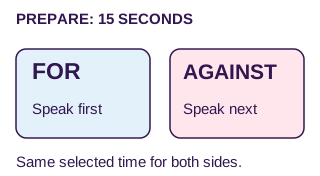
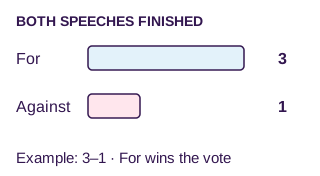
Absurd Debate Duel puts two speakers on opposing sides and provides equal preparation and speech timers. The audience then records its votes. That structure can make disagreement playful because everybody knows when a turn begins, when it ends, and what a ballot represents. The screen does not evaluate reasoning. It counts this audience's choices. A person can enjoy a convincing defense of a view they would never adopt, and a speaker can lose a ballot after making the clearest point of the round. Neither result needs to become a judgment about the person.
The proposition needs a small common world
Before the clock starts, establish only the fictional facts needed to argue. If the subject is whether a clock should be allowed to take holidays, decide whether the clock has feelings and whether people have other ways to tell time. Without that shared ground, one speaker may make a labor-rights argument while the other explains how batteries work. Those can both be interesting ideas, but they are not yet responding to the same question. Clarification prevents an accidental change of subject from masquerading as an unbeatable argument.
Leave room for interpretation after those basics are settled. A debate with a complete predetermined list of benefits and harms can become a memory test. Ask speakers to discover which consequence matters most. One might value consistency, another flexibility, another the experience of a particular fictional resident. The proposition becomes useful when the speakers can connect an image to a consequence and explain why that consequence supports their side. Loud enthusiasm alone is not the same task, although an audience may still enjoy a lively delivery.
Fictional Example: the corridor requests an anthem
This story is invented. Its corridor proposition is a separate paper discussion, not a claim that this exact question appears in the live bank. A group rehearsing a community radio segment has ten spare minutes before recording. They try a debate about whether a fictional apartment corridor should play its own theme tune whenever someone walks through it. Tessa volunteers for the For side. Arun takes Against. Three others become the audience. They agree that residents can hear the tune but that it cannot reveal private information or be used to target a real neighbor.
Tessa's first instinct is to describe an enormous brass band following every visitor. The image makes the room smile, but she notices that it does not yet support the proposition. She changes her argument: a recognizable tune could turn a dull shared space into a small welcome. A returning resident would hear an ordinary threshold become an arrival. She plans to acknowledge that the music should be brief rather than pretending that nonstop noise is pleasant. That concession gives her a position she can explain within a short speech.
Arun prepares a different picture. He imagines a resident carrying a sleeping paper dragon through the corridor after an exhausting imaginary shift. Even the friendliest fanfare arrives at the wrong moment. His argument concerns the difference between a shared ritual and an unavoidable interruption. He does not need to claim that music is always unwelcome. He needs to show why the corridor's habit should not decide for everybody. The paper dragon is a fictional detail that makes his consequence visible without bringing a real participant's circumstances into the joke.
The host gives both speakers the same preparation window and the same speech time. Tessa finishes early, briefly tempted to fill the remaining seconds with another image. She stops instead. Arun begins by recognizing that an arrival tune might be pleasant when invited, then argues that the corridor cannot tell when an invitation exists. A member of the audience laughs at the dragon and immediately raises a hand to add another objection. The host holds discussion until both speeches have finished. That pause protects the second speaker's time rather than allowing audience enthusiasm to become an extra opponent.
When the votes are collected, Tessa wins narrowly. Arun looks surprised because several listeners had nodded during his speech. The host asks what people chose to reward. One voter preferred Tessa's positive picture of a welcome. Another admired Arun's reasoning but voted for the premise they most wanted to imagine for one fictional afternoon. The criterion had been described loosely as the more appealing case, so both readings are understandable. Rather than arguing about whether the tally was wrong, the group makes the next round's criterion more precise: strongest connection between claim and consequence.
The useful turning point is not that one side wins. It is that the ballot exposes an ambiguity in what the audience thought it was choosing. The speakers had shared a proposition but the voters had not fully shared a criterion. A host can prevent that confusion by announcing whether the audience should reward coherent reasons, playful persuasion, or the fictional policy they would adopt. None is inherently the correct party-game goal. The problem comes when a speaker learns only after voting that the audience was assessing a different task.
Borrow the timing, not a promise of fairness by stopwatch
The live tool offers a short preparation timer and a speech timer for each side. Use them equally, but remember that equal seconds are one part of fair participation. A player reading in an unfamiliar language may need the proposition clarified before preparation begins. A speaker who prefers notes can write a few words rather than compose a complete paragraph under pressure. Make those arrangements before the timed turn, not midway through an opponent's speech when they can look like a special reward for one side.
Do not force a participant to perform because their name happens to be next in a rotation. Invite a voluntary speaker or choose another format. Someone who enjoys writing may contribute a premise or serve as a willing voter without wanting a live speech. If the group wants to adapt the activity into an untimed paper discussion, name that change openly. The fixed timer controls remain what they are; the host does not need to claim that a different spoken arrangement is an automatic feature of the software.
Timers can also create an unhelpful incentive to use every second. A short, complete reason is often easier to follow than a hurried list of unrelated points. Tell speakers that finishing a clear thought is an acceptable ending. If a timer expires midway through an example, apply the same stopping convention to both sides. The host can permit a final sentence or stop immediately, provided that the choice is stated beforehand. Improvising a longer finish for the most entertaining participant teaches the audience that the clock is only a suggestion for some people.
Illustrative Scenario: the defense nobody expected to enjoy
This second fictional example is a family paper debate about whether imaginary garden statues should elect their own mayor. An older child volunteers to oppose the proposal, assuming that statues have little need for politics. A grandparent takes the supporting side and chooses a very narrow argument: one elected representative could decide where a single wandering garden light belongs. The proposition is deliberately about fictional objects, so participants are not asked to imitate a real politician or argue over a family dispute.
The child begins with a practical objection. Statues cannot move, so their needs are different depending on where somebody has placed them. A mayor near the path might prioritize the path and forget the statue behind the shed. The supporting speaker replies in her allotted speech that this is exactly why the garden needs a representative who must listen to every position. Neither person has changed their real beliefs about elections; both have followed consequences within a shared imaginary problem. The disagreement becomes more concrete as each describes the same wandering light from a different place.
After the ballot, the child says that he preferred the opposing side's argument even though he delivered the other one. The host accepts that as an interesting observation rather than demanding loyalty to an assigned position. They end by asking which part of the proposition needed clarification: whether the mayor could visit each statue, whether the light could be shared, and what counted as listening. The family chooses not to run another vote. The discussion has already reached a natural stopping point, and repeating the tally would add less than a fresh activity.
This case shows a different kind of success from the corridor story. The useful experience is inhabiting a temporary argument and discovering a question inside it. There is no need to translate that into a lesson about the participant's maturity or moral character. A child can enjoy defending a fictional mayor without being praised for understanding democracy. A grandparent can enjoy the opposition without being teased for losing. Keeping the claim modest leaves the interaction available as a game rather than turning every lively exchange into an adult assessment.
Build one reason the audience can carry
A compact speech can follow a simple internal movement: state a claim, show a consequence, and explain why that consequence matters for the proposition. This is guidance for composing a turn, not an extra set of software fields. Suppose the claim is that umbrellas should have reserved seats on a fictional train. A speaker might picture wet umbrellas dripping down the aisle, then argue that a small designated place makes everyone's journey more orderly. The image does the work because it supports the chosen side rather than appearing as a separate joke.
An opponent can challenge the consequence without challenging the person. Perhaps a reserved seat would leave a weary traveler standing while an umbrella enjoys a cushion. That reply accepts the invented setting and identifies a competing priority. It is easier to follow than saying that the first speaker is ridiculous, which the game already admits about its premise. Encourage participants to refer to the proposed rule, example, or consequence. Avoid using the fiction as a cover for comments about someone's intelligence, accent, confidence, or habitual behavior outside the round.
The audience can help by listening for a connection worth remembering. Ask voters to make their choices independently before public explanations begin. If a confident listener announces a favorite first, others may follow the social cue instead of considering the two speeches. In the live tool, set the audience vote count to match the agreed participation and follow the ballot prompts. Do not invent a crowd statistic or imply that the displayed tally represents anyone beyond the people who actually voted in this local round.
A tie can preserve the best part
Some propositions genuinely produce two appealing imaginary consequences. A tied audience result need not trigger an emergency appeal for a decisive voter. The tool allows a tie. Let each side name the strongest idea from the other speech if they want to, then move on. That invitation changes the closing rhythm from pleading for votes to recognizing a construction somebody else made. It should stay optional: a participant may prefer to finish without another public contribution, and the host can simply summarize one difference that was already stated.
When a ballot is lopsided, avoid staging a consolation interrogation of the losing speaker. A host might mention one clear example or ask the group whether the next proposition should use a different kind of fictional rule. They do not need to manufacture agreement that every speech was equally persuasive. Respectful feedback can be specific and brief. The game is already a comparison. What it does not require is a permanent ranking of the people who briefly stood on either side of that comparison.
For a writing or speaking group that wants more detailed feedback, separate the workshop from the game. Finish the official ballot first. Then ask whether the speakers would like one observation about structure, clarity, or use of an example. Do not surprise somebody who volunteered for a light thirty-second performance with a long public critique. An agreed learning activity can be useful; an unannounced assessment can make people less willing to volunteer for the next round. The distinction is a hosting decision rather than a feature that a timer can enforce.
Let the proposition retire
An absurd debate is strongest when it can end while the imagined world is still amusing. After two speeches and a ballot, the group has completed something. It may continue the conversation, choose a new proposition, or stop. There is no obligation to keep generating objections until one person runs out. A host can protect that finish by announcing the round's shape before anyone begins. Knowing that the argument has a boundary makes it easier for speakers to commit to a strange position without worrying that they have volunteered for an endless dispute.
What remains afterward may be a corridor tune, a wandering light, or a surprisingly reasonable seat for an umbrella. The objects are fictional; the choices about clarity, attention, and turn-taking are practical. Read the premise together, give both sides the same chance to prepare, reward the criterion you actually announced, and count only the votes people submit. That is enough structure for a small imaginary argument to become a satisfying shared event, without pretending that a party-game verdict settles anything outside the room.